
Idaho politicians are using AI to write for them

AI detectors flagged dozens of op-eds and other statements published under the names of state constitutional officers and lawmakers, some of whom employ professional writers earning six-figure salaries. (Photo by Getty Images)
This story was 0riginally posted on IdahoEdNews.org on Oct. 21, 2026.
The next time you come across an op-ed by an Idaho politician, think twice about the source. It may not be human.
Op-eds and other online posts from some of Idaho’s most powerful elected officials contain heavy doses of artificial intelligence, according to AI detectors, tools that distinguish between writing by humans and writing that comes from machines like ChatGPT.
Idaho Education News started using these detectors last week after a series of stories from RANGE Media exposed a “startling” amount of “AI slop” in the opinion pages of Spokane newspapers and in written statements from candidates for political office.
EdNews turned up similar results. AI detectors flagged dozens of op-eds and other statements published under the names of state constitutional officers and lawmakers, some of whom employ professional writers earning six-figure salaries.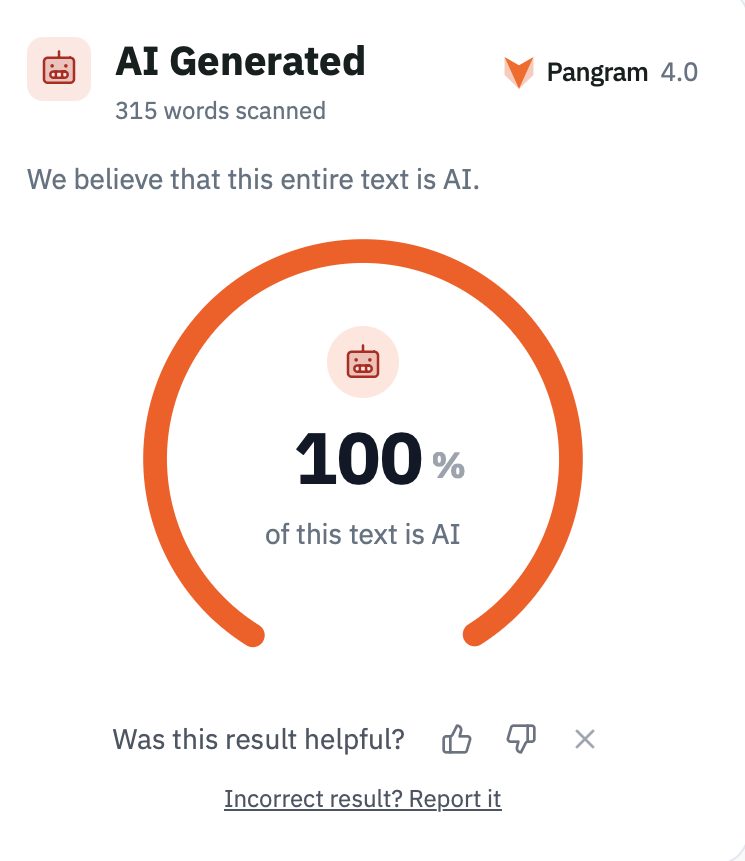
It’s common for high-ranking politicians to task staffers with communicating on their behalf. They write speeches, social media posts, op-eds and press statements. But if those staffers are outsourcing that work to artificial intelligence, it would raise questions around authenticity, transparency and accountability, particularly when machine-generated content isn’t disclosed.
Gov. Brad Little’s office this year published three op-eds that included AI-generated content, according to Pangram and GPTZero, two different commercial AI detectors. Attorney General Raúl Labrador’s office also published three, and State Superintendent of Public Instruction Debbie Critchfield’s office had two.
None disclosed that they used artificial intelligence.
The detectors flagged several other elected leaders, too. But many didn’t answer requests from EdNews to discuss their use of AI. Writing from Rep. Mike Simpson, Lt. Gov. Scott Bedke, Secretary of State Phil McGrane, state Rep. Josh Tanner and state Sen. Brian Lenney triggered the detectors.
Those who did talk to EdNews cast doubt on the reliability of AI detectors. Critchfield’s spokeswoman denied using AI at all. Spokespeople for Little and Labrador conceded that they use AI tools but not to the extent that the detectors suggested.
Spokespeople acknowledge some AI use
Daniel Estes, communications director for Labrador, acknowledged that he and Damon Sidur, director of external affairs, use AI when they write op-eds for Labrador.
ChatGPT and Claude help make their writing clearer and distill complex legalese stemming from the cases they often write about, Estes said in an interview at his Statehouse office. But he denied that AI does most of the work. Labrador edits the op-eds himself before they’re published, he said.
“There’s nothing that we’ve cranked out that hasn’t been reviewed and edited and changed, often substantially,” Estes said. “I disagree, vehemently, that these are AI-written.”
Pangram determined that Labrador’s op-ed celebrating Idaho’s settlement with Meta was entirely AI-generated. Two others included a majority of AI writing mixed with some human contributions, according to Pangram. The detector estimated that an op-ed about banking scams was 92% AI, while a letter reflecting on the Sept. 11 terrorist attacks was 81% AI.
Read Pangram’s reports here, here and here.
Most of the writing from Labrador’s office that EdNews tested was not primarily AI-generated, according to the detectors.
The same goes for Little’s office, although the detectors did flag three op-eds from the governor. Pangram determined that one on nuclear energy was 100% written by AI. Another op-ed applauding the state’s “fiscal discipline” was 88% AI, and a third on investments in teacher pay was 67% AI, according to Pangram.
Read Pangram’s reports here, here and here.
In response to EdNews’ request for an interview, Emily Callihan, the governor’s communications director, recited a prepared statement. EdNews did not accept written comments from the elected leaders and spokespeople mentioned in this story.
“AI detectors are frequently wrong,” Callihan said by phone. “That said, AI did not write the three op-eds you noted, but AI has replaced the use of other writing resources, such as an online thesaurus and editing tools. So it is accurate to say the governor’s office uses AI to assist with some writing.”

The ‘stylistic quirks’ of AI
AI detectors aren’t foolproof. Estes pointed out that earlier versions of the detectors flagged the U.S. Constitution as being AI-generated.
But that was three years ago, and the technology has improved.
The detectors, which are AI-powered themselves, have been fed millions of texts written by humans and millions of texts written by AI models like ChatGPT, Claude, Gemini and Grok. Then they were trained to identify common writing patterns from each source.
“AI models have many visible and invisible stylistic quirks unique to them that determine how they write, and that is what Pangram picks up on,” Annamieka Aerts, a technical writer at the company, said by email.
When Pangram released the fourth iteration of its AI detector this summer, the company touted a false positive rate — when human writing is incorrectly labeled as AI — of just 0.0041%, or roughly one for every 24,000 documents.
An independent study of commercial AI detectors by researchers at the University of Chicago last year found that Pangram’s software achieved “near-zero” error rates when analyzing texts that were medium-length (news stories and blogs) to long (novel excerpts).

Still, the detectors can be wrong, so EdNews didn’t rely on just one. EdNews tested writing that Pangram flagged as AI-generated with a second detector, GPTZero, which confirmed Pangram’s results.
Both determined that humans wrote the U.S. Constitution.
The detectors can distinguish between texts that were entirely AI-generated, a mix between AI and human writing or only edited by AI.
They noticed, for instance, that a recent op-ed by Lauren Necochea, chairwoman of the Idaho Democratic Party, was “AI-assisted.” Ironically, the article argued that data centers shouldn’t get tax breaks, in part, because of their environmental impact. Necochea told EdNews that the Democrats’ communications director, Avery Roberts, uses an AI tool to “polish” op-eds.
“I don’t seek out AI tools, in general, as a personal policy,” Necochea said by phone. “I worry about my own (writing) skills degrading. I think we all need to be conscious of not becoming dependent on AI. That’s what these companies want.”
Testing Pangram’s AI detector
When Pangram’s AI detector analyzes a text, it parses the writing into three possible categories: AI-written, AI-assisted or human-written.
EdNews took one of its own articles — last week’s coverage of a televised debate between candidates for state superintendent — and inserted changes made by ChatGPT to test how this works. We asked Pangram to analyze the article each time AI made changes.
First, we asked Pangram to test the original article for AI.
- Pangram result: 100% human-written.
Second, we asked ChatGPT to edit the original article.
- Pangram result: 23% AI-assisted and 77% human-written.
Third, we asked ChatGPT to rewrite the AI-assisted article.
- Pangram result: 12% AI-written, 55% AI-assisted and 33% human-written.
Lastly, we asked ChatGPT to write its own article based on the superintendent debate.
- Pangram result: 100% AI-written.
‘We write our stuff,’ says Critchfield spokeswoman
Pangram also flagged two op-eds from Critchfield — one highlighting student success was entirely AI, according to the detector, while another op-ed about Critchfield’s recent funding formula listening sessions was primarily AI.
Read Pangram’s reports here and here.
Andrea Dearden, communications director for Critchfield, denied that her office uses any AI tools to write op-eds. She writes them with Maggie Reynolds, public information officer for the Idaho Department of Education, and Critchfield.
“These articles, specifically, are very personal to her,” Dearden said of Critchfield. “She wants the community to understand her perspective.”
Dearden shared drafts of the op-ed, passed back and forth between herself, Reynolds and Critchfield, to demonstrate that humans wrote it. And Pangram showed that an early draft was 100% human-written. But the detector also showed that a later draft, which included significant edits to the original, was 74% AI-written.
Dearden appeared perplexed by the results, but she stood her ground in a follow-up interview.
“We don’t use AI. We write our stuff,” she said by phone. “We go through multiple iterations, through multiple people, and if we used it, we would tell you.”
GET THE MORNING HEADLINES.
Ver nota original ↗
¿Querés un resumen rápido de esta noticia, hecho por nuestra IA?


