Dartmouth provost resigns after review finds undisclosed AI use
This story by Molly Hughes was first published in the Valley News on Oct. 28, 2026.
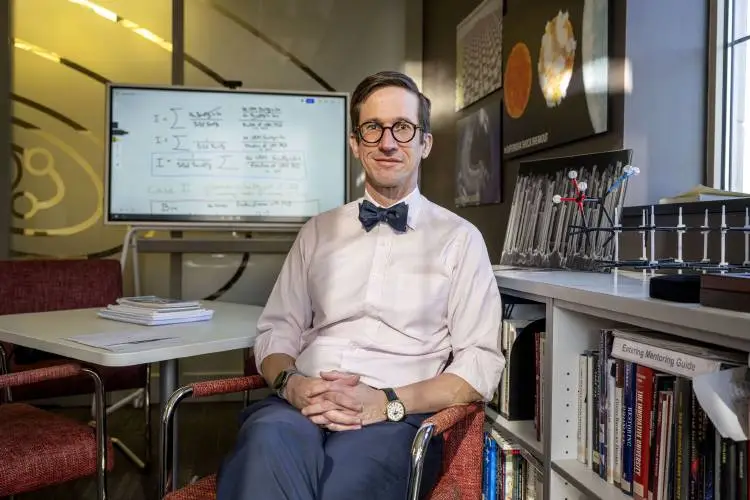
HANOVER — Dartmouth Provost Santiago Schnell has resigned and is leaving the university after a faculty-led committee found he used artificial intelligence in his writing without properly disclosing it.
President Sian Leah Beilock announced the resignation Wednesday afternoon in an email to the campus community.
“Out of respect for his colleagues and the institution, Santiago has resigned as provost and is leaving the university,” Beilock wrote. “This was his decision.”
Beilock formed the committee on Sept. 25, after news reports questioned Schnell’s use of AI, including an August Semafor article about AI-written opinion pieces that named his Washington Post column.
In its report, dated Oct. 27, the committee found that Schnell “used AI to meaningfully alter his writing in violation of at least one publication’s AI use and/or disclosure requirement, failed to disclose his use of AI in clear violation of a national newspaper’s stated policy, was not forthcoming about his AI use,” and fell short of Dartmouth’s ethics and professionalism standards.
The committee said it did not use AI detection tools. Instead, it reviewed Schnell’s logs from Dartmouth’s enterprise AI tool, Claude, along with his emails. It also noted that it was not recommending any disciplinary action.
Schnell has published at least 30 pieces since joining Dartmouth in July 2025, according to the report. Given the short timeline, the committee focused on a handful of them.
In one journal paper, the committee found Schnell used Claude to “substantially edit his research manuscript, troubleshoot errors in computer code, and generate figures.” The journal required that kind of use to be disclosed, and Schnell did not disclose it. He told Beilock in a Sept. 22 email that he had relied on older author instructions.
“This wasn’t the case, but a disclosure would have been the best approach,” Schnell wrote, according to the report.
The committee said the publisher has required AI disclosure since at least 2023.
Schnell told Semafor he used ChatGPT “to refine a few arguments, check for grammatical errors, and submit it to the Washington Post.” The committee said that was a “clear violation” of the Post’s policy.
According to the committee, in a forthcoming article, Schnell uploaded his manuscript to Claude and asked, “Are there many signatures of AI writing in this article?” He later submitted a version with the kinds of changes Claude suggested. When the journal’s editor asked about AI use, Schnell said he “did not understand that this type of AI-assisted editing required disclosure.” The committee said his description “understates the nature of the Provost’s actual AI use.”
The committee found no violation in a fourth paper, which Schnell co-authored.
The report also says Schnell did not fully cooperate.
“Although he did provide his Dartmouth-issued laptop for inspection, the Provost did not, upon request, provide logs of his use of personal LLM accounts that he used for his academic and public writings,” the committee wrote.
Former provost and computer science professor David Kotz led the committee. Its other members were computer science professor Hany Farid, English professor Peter Orner, linguistics professor Lindsay Whaley and trustee Odette Harris.
Schnell did not respond to an email seeking comment Wednesday, and Dartmouth Director of Media Relations & Communications Strategy Jana Barnello did not immediately respond to a request for comment.
History professor Matthew Delmont will serve as interim provost through June 2028.
In her letter, Beilock said leaders must “model the transparency and human judgment that we expect from our students and scholars.” Dartmouth hosts its “AI at 70: What Must Remain Human?” conference later this week.
Read the story on VTDigger here: Dartmouth provost resigns after review finds undisclosed AI use.
Ver nota original ↗
¿Querés un resumen rápido de esta noticia, hecho por nuestra IA?