‘The CTE risk': Parents embrace flag while weighing downsides of tackle football
Sandeep Basran’s 9-year-old son has been playing football in the Chicago area for four years and has had only a minor leg injury this season. That’s not an accident.
He’s on a flag football team, with no blocking or tackling.
Basran is among the parents who are paying attention to the pervasiveness of brain injuries suffered by professional football players, revelations that are spurring an interest in flag, at least for younger kids.
“The big concern is the CTE risk,” said Basran, who is an assistant coach for his son’s team. “My understanding, based on the research, is that it’s not just the big hits that affect the brain; it’s also the minor, repetitive hits that happen on every play, and those can add up over time.”
Studies on the prevalence of brain injuries — specifically the degenerative disease CTE or chronic traumatic encephalopathy — are changing the way the parents like Basran look at tackle football. When should kids start playing? How can they learn safer ways to play? Should they even play at all?
That’s where flag comes in.

It’s not the same, but it’s more than just a safe substitute. Flag has its own specificities, its own intricacies and its own strategies. It’s a non-contact sport with fewer players on the field at a time, less equipment and a faster pace of play.
And, of course, the safety aspect is part of what makes flag such an ideal alternative. As flag becomes more popular, many parents across the country are opting to stay away from tackle.
Basran, who also has a 5-year-old daughter, is mostly concerned with head injuries. He has turned his son away from tackle despite getting questions from the 9-year-old boy, as some of his friends have started playing tackle.
“Another reason we say no is that my son plays other sports,” Basran said. “If he suffers a football injury, that could affect the next season, which he loves — basketball, tennis, golf and other sports. We don’t want to jeopardize those.”
Basran’s son plays in the i9 Sports flag football league, where he’s never had a head injury.
“I suspect that for us it will continue, and he’ll keep doing flag because he loves football,” Basran said. “I think his questions regarding tackle will lessen as he continues to develop in his other sports.”
A study of CTE published in April examined the brains of former NFL players who died from 2016 to 2021. It found that at least one in four players had the degenerative brain disease. Among the 1,712 NFL players who died, 338 of their brains were studied and 315 of them had a diagnosis of CTE.
In a subsequent study published on Wednesday, the same research team aimed for a better estimate of the prevalence of CTE among all deceased players, not just those who had donated their brains. They concluded that an estimated three out of four players who died from 2008 and 2023 most likely had CTE, the highest estimate so far.
Researchers have found that people with cognitive decline and their families are much likelier to donate their brains and ask for autopsies. So they not only used data from the UNITE Brain Bank at Boston University’s CTE Center, but also from national death records of other former NFL players who died in that time period.
The researchers looked at 396 donated brains plus information from 1,966 other deceased former NFL players to reach their estimate.
In an emailed statement, an NFL spokesperson told NBC News, in part, that the league “continuously strives to make the game of football safer, including by implementing strategies to reduce concussions and head impacts.”
Basran isn’t alone in his concerns about tackle and his excitement about flag, especially given the recent studies.
In San Diego, parents with children in the Football ‘N’ America league see flag as a competitor to tackle’s popularity. They play on Friday nights, similar to high school tackle football under the lights — and it’s growing even quicker with girls being able to play, too.
“You’ll see the community, the parents that come out, once it starts to get dark and the lights go on, it’s a really cool scene and I think the kids love flag football, especially,” said Tim Lewis, a parent and coach in San Diego.
Lewis has a 10-year-old son and an 8-year-old daughter who both play flag, among other sports. While the boys have been rolling for years, he’s starting to see massive growth with the girls.
“What I’m really finding out now is I’ve coached these boys for five years, and now I’m coaching a girls team, and they’re the ones who you’re really seeing flag football explode,” Lewis said. “That’s happening at a high school level. Torrey Pines High School down the street. We had a girls flag football event where we all went and watched the girls flag football game at Torrey Pines, and then all the girls flag football players (watching in the crowd) got announced at halftime.”
It (has) exploded. I read that it’s the fastest growing sport among girls in the country. … And it’s equally as popular (as tackle at this level) and they’re definitely having as much fun.
Tim Lewis
Joe Becker, who owns i9 Sports in Chicago, is also excited about the growth of flag for girls.
Unlike boys, who have more of an opportunity to play tackle, flag is the main outlet for girls to get their football fix.
“Girls flag football is something that we’re really trying to market and push because it’s now an Illinois sport for girls’ high school,” Becker said. “And now it’s gonna be in the Olympics. So, I think there’s gonna be a lot of growth there. And that’s something that we love. I mean, I love to see girls playing football. And I think that’s going to be a growing sport for girls in particular.”
Between 2019 and 2024, flag football was the only team sport tracked by the Sports and Fitness Industry Association that grew among kids ages 6 to 17. That’s according to a report last year from the Aspen Institute, State of Play. Tackle football was down 7%, while flag football was up 14%.
Flag passed tackle in 2017 as the most commonly played form of the game among the kids 6 to 12, and by 2024, 4% of kids in that age group were playing flag compared to 2.7% for tackle.
But for those who are older, 13 to 17, the opposite is true and tackle remains much more popular, the report notes. In that age group, 6.4% plays tackle compared to 2.8% for flag.
“Flag’s growth is largely attributed to the NFL, which has invested in the sport more as some parents delayed or walked away from tackle due to the risk of brain injuries and shifting U.S. demographics,” the report says.


NFL FLAG serves more than 620,000 kids ages 4 to 17 across the country. The NFL campaigned for flag football in high school for girls, the report notes.
Part of what makes tackle so popular is the camaraderie and battle-like mentality that comes with it. But flag, according to parents and coaches, is starting to deliver the same results for kids.
Rashad Crawford knows that better than anyone else. A former college football player at Indiana State, he now mentors young players in the Chicago area.
“That camaraderie and team aspect, I think it’s still there, it’s still prevalent,” he said. “I think when you score a touchdown, you still have the same excitement and want to bust out your best moves as far as a celebration. Kids actually plan that. I can hear them in the huddle like, ‘Hey, if we score this touchdown, this is the celebration we’re going to do.’ So, I do think that there’s still that brotherhood, sisterhood bond that goes into sports elements, regardless if it’s tackle or flag.”
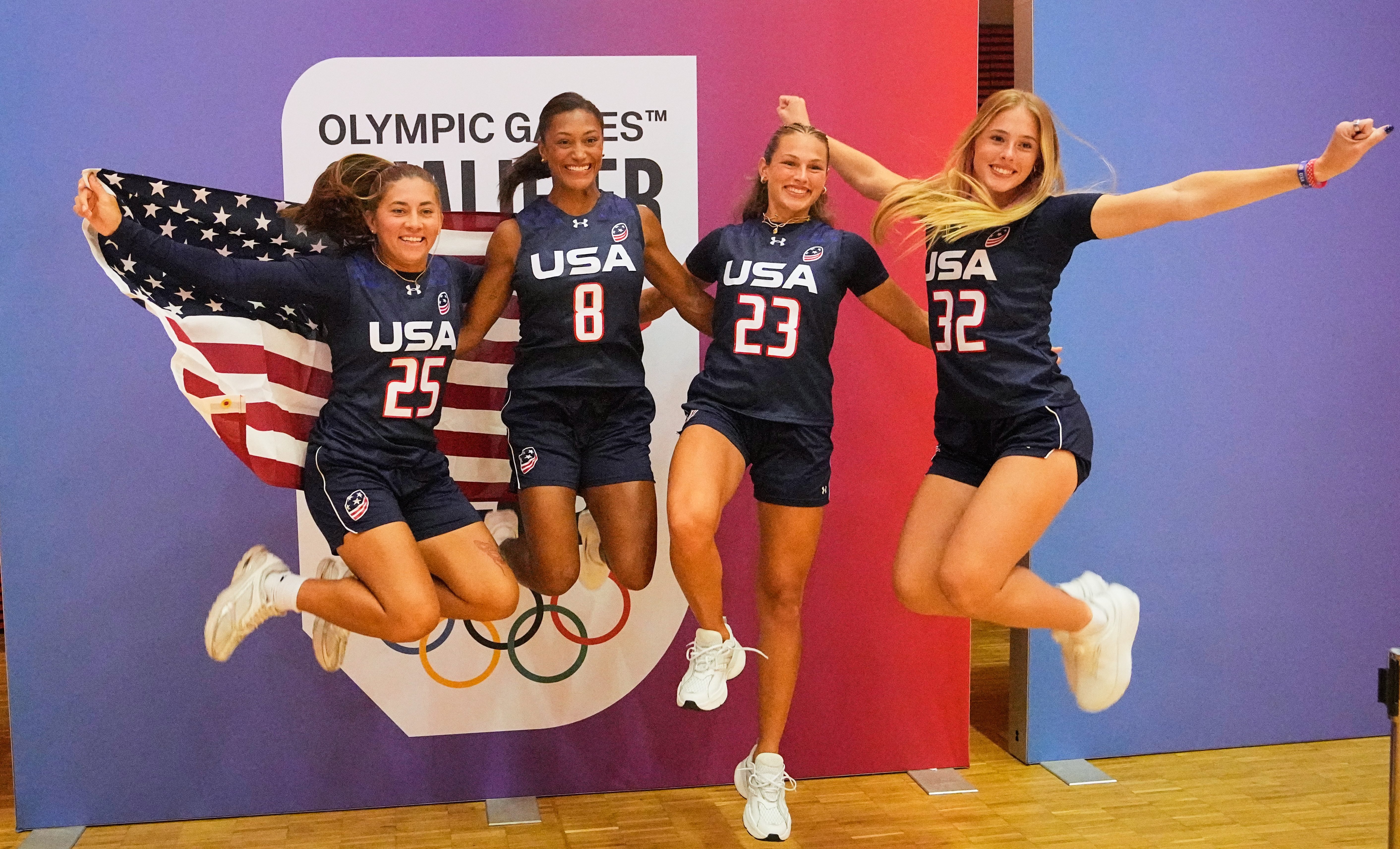
As flag continues to grow, it will soon be on full display on the world’s biggest stage. The sport will debut as an official Olympic sport in 2028 at the Los Angeles Games.
For Crawford, that platform could be the start of something even bigger. Participation for children keeps rising, which could lead to something more as the generation grows up.
“I see it becoming a professional sport,” Crawford predicted. “I think that the brand of flag football, it’s coming to the Olympics. You have nationals, you have national championships for flag football, you have (Amateur Athletic Union) flag football, you have so many different travel leagues.
“I think just because of the amount of visibility that flag football is getting, I think the sky’s the limit. I think within the next four, five, six years, I think you really have to have talks about how we can make this into a professional sport and what that will look like, especially if everything goes well in the Olympics and you get that viewership that you are looking for. I think you have to consider it becoming a professional sport.”
‘I can’t watch a minute of it’
While flag makes its mark, the medical risks of tackle are becoming harder to ignore for some.
Robert Stern was a fierce football fan. He was one of those fathers screaming on the sidelines of his oldest son’s football games from the Pop Warner youth league on to high school. He loved the New England Patriots, hosted Super Bowl parties and when the Patriots were in the championship game, he could hardly imagine anything better.
“And now I can’t watch a minute of it,” he said.
Stern, co-founded Boston University’s Chronic Traumatic Encephalopathy Center nearly 20 years ago, and in that time, he has been researching the brain damage left by football.
“We’re not meant to be woodpeckers,” said Stern, a professor of Neurology, Neurosurgery and Anatomy & Neurobiology at Boston University’s School of Medicine. “Or battering rams, so to speak. We’re meant to be using our brains as human beings.”
CTE is a progressive brain disease found in people who have been hit in the head repeatedly — found most among football players, those who play other contact sports and members of the military, according to the CTE Center. It was observed in boxers in the 1920s, when it was called punch drunk syndrome.
The hits trigger the degeneration of brain tissue and a buildup of an abnormal protein called tau, changes that can begin decades later, the CTE Center says. The pattern of tau found in those with CTE differs from other neurodegenerative diseases such as Alzheimer’s.
There is no cure for CTE, which can only be diagnosed definitively after death. The Boston University CTE Center houses the UNITE Brain Bank, the world’s largest that is focused on brain trauma.
Concussions can have serious short-term repercussions and contribute to CTE, Stern and others note, but a concussion can get better with appropriate care. A football player who never had a concussion is still at risk for developing CTE.
“It took looking at brain banks for us to be certain that CTE is incredibly rare in the population that’s just had a couple of concussions,” said Chris Nowinski, another co-founder of the CTE Center and the CEO of the Concussion and CTE Foundation.

In a sport like football, it is not possible to prevent all cases of CTE, he said.
Stern and Nowinski are among the authors of both recent CTE studies.
Dr. Daniel Daneshvar, the lead author of the August CTE study, said that eliminating hits during practices and limiting young people’s participation in tackle football would help lessen the risk of developing CTE.
“We know that nearly 70% of head impacts are occurring in practice. So without changing a single minute of game time at any of those levels, we can be substantially reducing the cumulative head impact burden that these individuals are experiencing throughout their lives,” he said when the study was released.
New helmets introduced to the NFL about five years ago are required for players at certain positions — ones with higher contact risk (running back, linemen, linebackers, tight ends) — in practices but optional in games. Called a Guardian Cap, the padded covering is worn over a traditional football helmet and is meant to reduce the impact of hits, according to the company.
Some high school students also wear a version of the cap, but it is different from the one NFL players use, the Guardian Cap NXT.
Two recent studies examined their effectiveness in preventing concussions. One in 2025 of 2,610 Wisconsin high school football players determined that wearing the cap during practice had no effect on the rates of concussions.
The other looked at their use in NFL preseason practices. Laboratory testing had shown that the cap reduced head acceleration in test dummies compared with a helmet alone, and required use of the cap was associated with a 54% to 62% reduction in NFL practice concussions, the study noted.
“However, when only concussions involving a helmet shell impact were considered, there was no longer a significant relationship between Guardian Cap NXT use and the incidence of concussions,” it said.
Erin Hanson, co-founder and CEO of Guardian Sports, told NBC that the company was not focused on concussions.
“We’re not looking at that big concussion,” she said. “We’re looking at that accumulation of all of those non-concussive hits over the course of a player’s career.
Nowinski, however, has said there is no reason to believe the caps are helping high school or college players. The jury also is out on whether they help NFL players.
“Helmets are never going solve the CTE problem, because the problem is rotational acceleration, the brain pulling apart, which helmets do a terrible job mitigating,” he said.

To the argument that adults can make their own decisions about playing tackle football, assuming they understand all of the risks, Stern offers a counter one: The NFL is a job.
“There’s no other occupation that has, as far as I know, that has that type of risk for a later life disease or problem,” he said.
But in the case of the NFL and unlike other workplaces, the federal Occupational Safety and Health Administration has not taken action. And under the Trump administration, OSHA has proposed exempting inherently risky professional activities, including sports and entertainment, from the agency’s oversight though no changes have taken place yet.
Football is such an enormous part of American culture that it is difficult for people to acknowledge the harm it can cause, he said.
“The very nature of the game is a brutal, violent game,” he said. “That’s why we love it. But one part of the body that gets hurt over and over and over again happens to be the most important part of the body and the most complex part of the body. And that’s the human brain.”
Ver nota original ↗
¿Querés un resumen rápido de esta noticia, hecho por nuestra IA?