Bennington Battle Monument dig reveals possible historic tavern, artifacts

This story by Jeff McRae was first published in the Bennington Banner on Oct. 27, 2026.
OLD BENNINGTON — The archeological dig at the Bennington Battle Monument State Historic Site in Old Bennington was open Monday, Oct. 26 for tours, with members of the Vermont Division of Historic Preservation on hand to make the pits and their thought-provoking revelations meaningful to visiting community members.
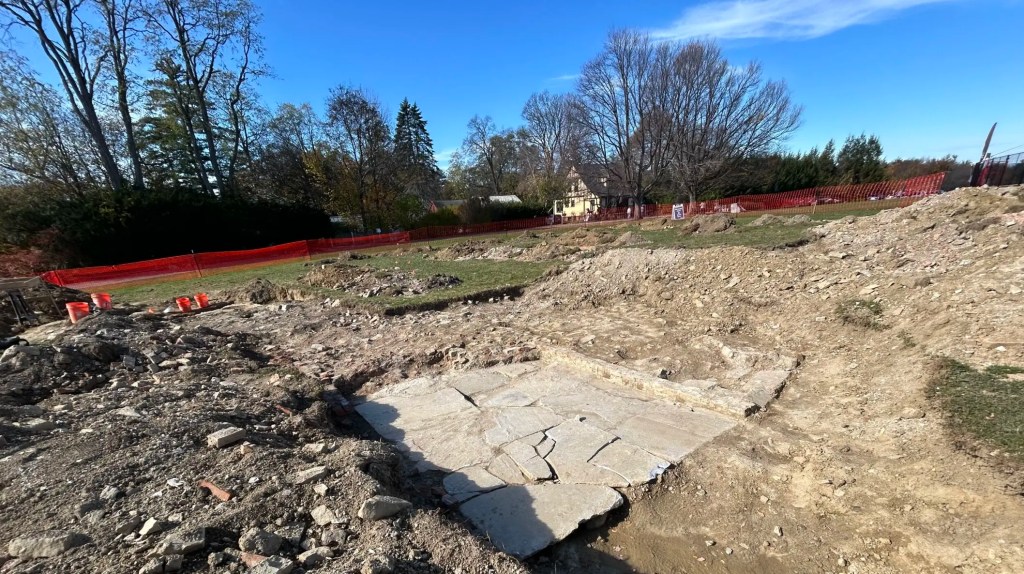
Visitors had the chance to view foundation outlines, partial brick walls and a spectacular set of flagstones researchers think may have marked the entrance to a long-gone tavern. At the other end of the green, a table was set up to display an array of small artifacts the recent excavations produced.
In addition to the familiar antique square nails and pottery fragments, researchers also uncovered objects more suggestive of life in Ye Olde Bennington.
“We have some really amazing finds,” said Joshua Bell of the Division of Historic Preservation.
“The pipe pieces actually had the mason symbol on it, which was kind of cool. That King George III coin speaks to the life that was happening here.
“We’re really excited for this archaeology to be done,” Bell said, “and for it to be open to the public. And we hope to find new ways to use what we have learned to enhance our interpretation here at the site.”
Discussions are underway as to what to do with the objects the team uncovers and where they’ll be kept.
“We are looking at having them go to our central location in Barre,” said Bell. “Jess Robinson, our state archaeologist, has a collection there. But we want to make sure that we’re able to use these everywhere. So we can check them out and show people.”
Bell thinks there is much more the site can reveal, but said the dig will be winding down by the end of the week.
“We are going to start slowing down here a little bit, and at the end of the week, start covering things back up. We originally anticipated having to go down 6 to 8 feet,” he said. “We were very pleasantly surprised that most of it was right near the surface.”
On Monday, visitors were allowed inside those areas for a close encounter with the distant past.
“We’re very excited by the turnout today,” said State Archaeologist and Director of the Vermont Archaeology Heritage Center Jess Robinson. “We certainly got a lucky day with the weather and the temperature,” he said, indicating the blue sky and the more than two-dozen people touring the site.
“It’s a testament to the interest in the greater Bennington area in the history of this place and everyone’s part in it. People (in the Division for Historic Preservation) are really, really excited not only by the turnout, but the (community) enthusiasm has been really remarkable. And it really excites us and makes us glad that we’re doing this stewardship project.”
Robinson described a multi-step process he and his team followed.
“The first step was sort of some basic archival research, getting into some more advanced stuff about the history of this area prior to the construction of the monument in the green,” he said. “And then (we conducted) a ground-penetrating radar survey that, combined with where we thought buildings would be based upon the archival research, revealed some tangible deposits, although their outlines and parameters were still pretty vague.
“We thought something might be still intact here, but we were very surprised with the degree of integrity and interpretability that we’re seeing here.”
Visitors, both local and from farther afield, slowly circulated through the site that, as previously reported, researchers need to first assess before repair work to the monument begins so artifacts and structures, where possible, can be avoided during future construction.
The project is federally funded through congressionally directed spending administered by the National Park Service.
Cynthia McGuire and her family came over from Cambridge, New York, to enjoy time together with husband Jim and their two adult sons, Dan and Gavin, the latter home on leave following an “extra-long stint” aboard the U.S.S. Abraham Lincoln. He also holds a degree in anthropology with a focus in archaeology.
“So, we’re here to take a look,” she said.
Among the many interesting things to see, none is more interesting, perhaps, than what Robinson and his team think might be the threshold of the former tavern and, in what would have been the rear of the building, a round, stone-lined structure they initially thought looked like it might have been a well or cistern.
“But it doesn’t appear to be,” he said. “It actually shallows out and comes to a stone base. And if you go look at it, there’s an interior circle of brick, and then bricks protruding from the outside.”
“Now the thought is it might be some sort of brewing vat or tank or even a large storage tank for barrels. So that would probably indicate that that’s more the back-end kitchen brewery side of (the possible tavern).”

He and his team will soon be busy trying to assemble the narrative of the site from the artifacts they’ve found and what structural elements they’ve uncovered.
“A lot of this isn’t going to be teased out until we look at what artifacts were found where within the structure which will give an indication of use,” he said. “If we find kitchenware and things, we’ll be able to say, ‘Oh, OK, this was either the dining room portion or perhaps the kitchen area.’ Other artifacts will tell other stories, so a lot of this is (yet) to be determined until the synthesis and analysis (is complete).”
Visitors will have only a few more days to see what has turned up at the evocative site before the archeological and preservation crew begins the process of filling the pits back in with Bennington earth.
“We don’t want to leave it exposed for too terribly long, particularly when the bad weather starts coming in, which it will. If we get a big, heavy stretch of rain, this will turn into a swimming pool, which we don’t want,” Robinson explained.
“We’re going to lay down geotextile fabric over all these important site components. And that will basically protect it. Then, the plan now — and it might change, we are actually in active discussions — but the plan now is to take a lot of the rubble out of this fill, fill (the pits) in carefully, and then it’ll be intact here for future research education.”
Eventually Robinson and his team will make available a report that will tie together everything.
“The town will certainly be privy to the final report that comes out of this and any other publications we’re going to share widely,” he said.
“The only concern we ever have with sharing archaeological materials is that locations might be compromised. But there’s no hiding this. We don’t want to. We want to make it as public as possible. And so all the literature and products that come out of this archaeological work are going to be shared broadly and widely.”
The monument site will remain open to visitors through Oct. 31.
Read the story on VTDigger here: Bennington Battle Monument dig reveals possible historic tavern, artifacts.
Ver nota original ↗
¿Querés un resumen rápido de esta noticia, hecho por nuestra IA?