More raw sewage, billions of gallons of it, is pouring into the Chicago River after storms

Joe Gamble knows what to expect when he arrives at work at the Bridgeport Art Center after days of heavy rain.
“There was raw sewage floating in the creek,” Gamble says after storms in early October. “The wind carried the smell for at least a block or two.”
The Bridgeport Art Center sits along the South Branch of the Chicago River at a spot known as Bubbly Creek, a small body of water that marks the South Fork of the river and divides Bridgeport and McKinley Park.
It’s a really disgusting spot after big storms.
Layers of feces, condoms, tampons and other items flushed down toilets float past and get stuck in the low-lying trees along the shoreline. There are so many condoms that they’ve picked up a nickname: “Chicago whitefish.”
More and more people have been drawn to the river in recent years for recreation, many of them taking to the water in canoes and kayaks.
Bubbly Creek appeals particularly to beginner rowers and paddlers because it's calm and easy to navigate. After storms, though, it often stinks so badly that the smell clings to Gamble’s clothes even after he’s left the area.
“I am sometimes tolerant of smells,” says Gamble, who works at the Chicago Maritime Museum, “but it’s a different level.”
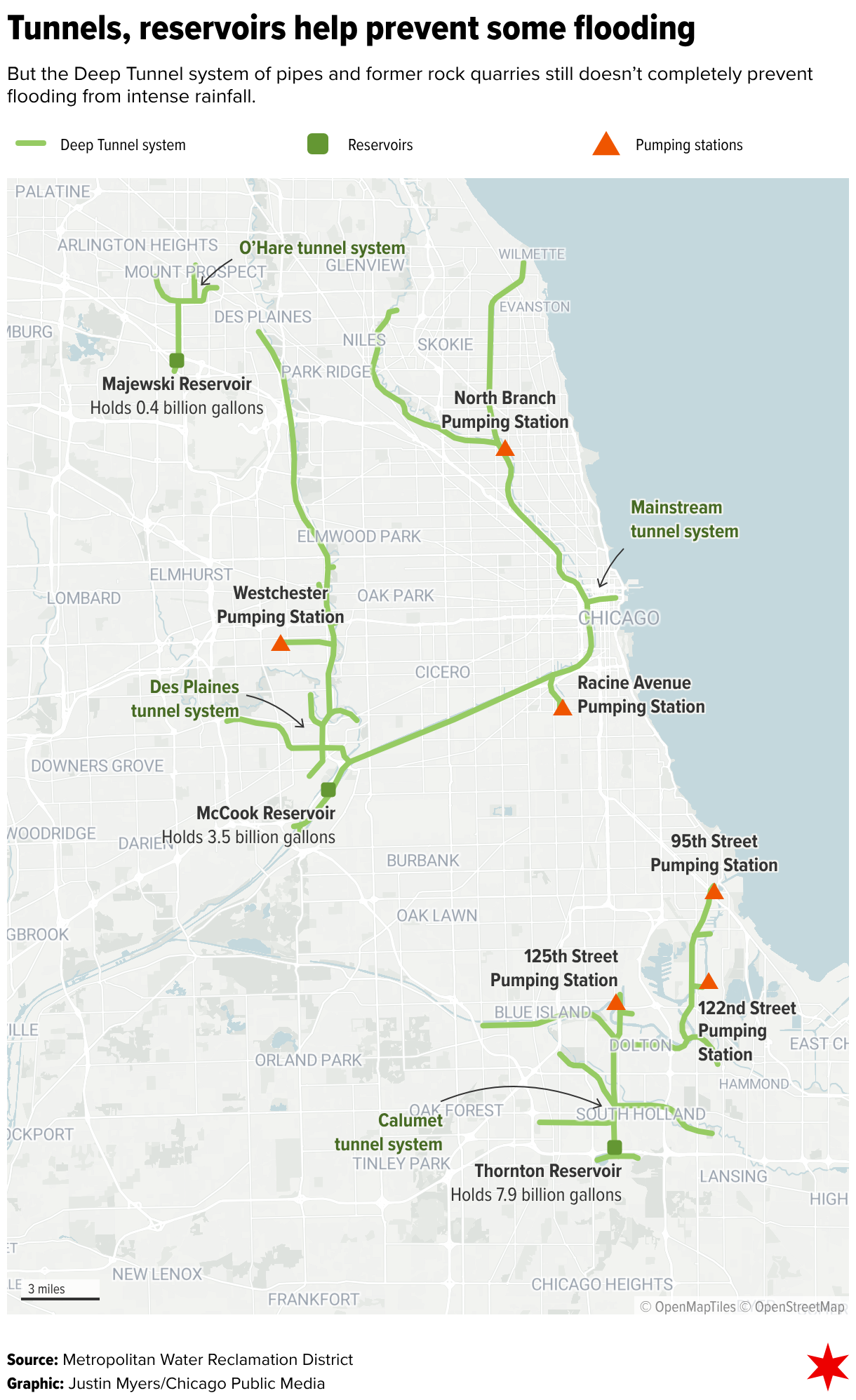
The culprit behind the stench? A sewage pumping station on Racine Avenue south of the Bridgeport Art Center building. The Racine Avenue pumping station has big pumps that help move sewer water — both wastewater and stormwater — to a treatment facility where it's sanitized, then sent on to the Chicago Sanitary and Ship Canal, then the Des Plaines and Illinois rivers and ultimately to the Mississippi River down to the Gulf of Mexico.
But sometimes the Metropolitan Water Reclamation District of Greater Chicago, the government body that operates the station, says heavy rains mean it needs to dump untreated sewage directly into the river to prevent flooding of homes.
And it’s a lot of sewage. This year, the Racine station, which is nearly 90 years old, has dumped more than 10 billion gallons of sewage into the river. That's more than it has since 2019. In Chicago, storm water and wastewater go into one big sewer.
Like what happens at the Racine station on the South Side, the water reclamation district's North Branch pumping station — at Lawrence Avenue and the river on the North Side, on the border of Albany Park and Lincoln Square — has spewed nearly two billion gallons of untreated sewage this year into the North Branch of the Chicago River.
And all of this is happening despite the billions of dollars in taxpayers' money that has been spent over 50 years on the Deep Tunnel project, the sprawling system of more than 100 miles of underground tunnels and massive reservoirs designed to capture floodwater in the Chicago area and help protect the river and Lake Michigan from pollution.
The Deep Tunnel is one of the many ways that government officials in Chicago and engineers have tried to adapt a big city that originally was built on a swamp and remains highly prone to flooding to its environment.
But climate change has complicated those efforts. It's contributing to intensifying weather patterns that bring storms that drop rain faster and harder than ever before. That overwhelms our sewers, streets and homes.
These intense storms can bring us more than 8.5 inches of rain in just 24 hours.
But Chicago's sewer system, designed decades ago, can handle just two inches of rain before flooding is likely.
All of that sewage flowing into Bubbly Creek and the North Branch of the river isn’t just gross. It also poses a health risk for people with weak immune systems because of the bacteria and other pathogens the water carries. The contaminated water also can wreak havoc with nature, wiping out fish populations for weeks. That’s bad for the larger ecosystem, something that environmental advocates and government officials have been working over the past three decades to restore.
Tara Hoffmann, who is executive director of Recovery on Water, a group that has a rowing team for breast-cancer survivors, worries about keeping its members safe in the sometimes-nasty water. Some of the women have compromised immune systems following their cancer treatment. And they are out on the water, rowing, much of the time during warm weather months.
Hoffmann recalls a particularly bad day on the creek in June, when the women were paddling through excrement.
“One of the first things you notice," she says, "is fish up at the surface, gasping for air. They’re just desperate to breathe.”
A threat to wildlife
Both the Racine and North Branch pumping stations are owned by the water reclamation district. Since 2011, the independent government body that's in charge of treating sewage and reducing flooding around Chicago, has operated under a binding agreement with the U.S. Environmental Protection Agency over federal clean water violations related to the sewage.
District officials say the more intense storms we're seeing mean that Chicago needs more flood-prevention measures in addition to the Deep Tunnel, like creating green spaces and tapping other strategies in an effort to capture water before it reaches the sewers. The district has designed nearly 300 flood-mitigation projects, many of them still in the planning stages.
Raw sewage is a clear threat to the river's water quality, says Phil Nicodemus, who's the research director for the organization Urban Rivers, which works to make urban waterways in Chicago into wildlife sanctuaries.
“It dumps a bunch of nutrients into the water at the same time,” Nicodemus says of the sewage. “That causes a massive oxygen drop, which causes a huge die-off. If that happens enough times throughout the year, you might be talking about a whole summer without much oxygen at all. That creates an enormous problem for wildlife.”
On a late summer day, Nicodemus travels in a pontoon boat with a team surveying the floating ecosystems near River Park on the North Side, not far from the North Branch pumping station. He steers the boat. Urban River team members jump into the water and collect bug samples. These will be studied to help provide insights on water quality.
Other experts also are examining the problem of these raw sewage dumps in the river.
Bubbly Creek, a former longtime dumping area for discarded animal carcasses from the old Union Stockyards, was studied after a large sewage spill in 2023. What research biologist Austin Happel from the Shedd Aquarium found was disturbing.
The Chicago River provides a home to hundreds of animal species, and the sewage is having a dramatic impact on them, according to Happel. He has found that oxygen levels dropped while nitrogen levels rose significantly. Fish swam off and didn’t return until weeks later.
“There’s a stark shift in the food chain,” Happel says.
Oxygen in the water gets depleted. That makes it impossible for fish and other water life to exist. For weeks on end, the fish will disappear from the water, which flows into the South Branch of the Chicago River.
Deep Tunnel can’t keep up
The Deep Tunnel system includes more than 100 miles of massive tunnels hundreds of feet underground. The tunnels — basically giant pipes — range in diameter from under 10 feet to 35 feet. They help storm water flow to two former rock quarries in the south and southwest suburbs that can hold billions of gallons of water.
Cleaner water was one of the main reasons it was decided in the 1970s to build the Deep Tunnel, formally known as the Tunnel and Reservoir Plan. The Deep Tunnel also is supposed to ease flooding in and around Chicago. The costly flood-control measure has worked to a degree but not entirely. This is why the Chicago area still sees chronic flooding and the Chicago River continues to be tainted by sewage.
The intensity of the rains we now see are too much for the tunnel and reservoir system to handle as envisioned. It's being overwhelmed.
This summer, the biggest of the two quarries — the Thornton reservoir in South Holland — became filled with storm water for the first time since it was opened in 2015. That mean it contained nearly eight billion gallons of sewage. And it still hasn’t completely drained.
To the west of Chicago, the McCook reservoir in Bedford Park has filled up 10 times this year. Since it was opened in December 2017 through last year, that 3.5 billion-gallon reservoir had filled to capacity only five times.
McCook is now undergoing an expansion. Eventually, it's expected to hold 10 billion gallons of sewage water when it’s completed in 2032. The water reclamation district previously had told the EPA the expansion would be finished three years sooner, in 2029.
In the race against time and nature, “The efforts aren’t keeping up,” Nicodemus says.
Margaret Frisbie, executive director of the environmental advocacy group Friends of the River, agrees. As more people turn to the river for recreation, Frisbie says, the problems are being more widely noticed.
The answer, she says, will rely on a mix of many new and innovative smaller projects, including moves to create more green space across Chicago and to create structures that capture rain water before it gets into the sewers, where it ultimately can overwhelm the current system.
This year has been a whopper for rain, with more than 37 inches already recorded at O’Hare Airport and more rain forecast this weekend.
That's a big hurdle, according to Frisbie.
“I don’t think you can engineer your way out of that,” she says.
This article was produced as part of a project with a health and climate change reporting fellowship through USC Annenberg’s Center for Health Journalism and Center for Climate Journalism and Communication.
Ver nota original ↗
¿Querés un resumen rápido de esta noticia, hecho por nuestra IA?