Housing mobility programs help low-income renters move on up
In 1985, Gloria Washington was living in a subsidized apartment in Chicago’s Englewood neighborhood. She says it was infested with rats and roaches, and there were always people drinking and doing drugs outside the building.
“I didn’t want that life for my two little kids,” recalls Washington, now 70.
She heard from her cousin about the Gautreaux Assisted Housing Program, a court-ordered program meant to address racial segregation in Chicago that helped low-income residents move to lower-crime, higher-income neighborhoods and suburbs.
When she was offered an apartment in the far northwest suburbs, she immediately said “yes.”
Washington remembers hearing that she would be moving to Schaumburg. At the time, she had only heard of the village on TV ads for a Schaumburg auto dealership.
“I said, ‘Why are they moving me to a car dealing place?’ ” Washington says. “But I just went along with the flow. I just wanted to get out of what situation I was in.”
Soon, she moved into a brand new, three-bedroom apartment with her young daughter and son. Despite loving her new digs, Washington was nervous about the lack of sidewalks. She had no car and no job, lived away from family, and sometimes got racist comments from people while walking places with her children.
But Washington also had help from the local township to pay bills. She was able to send her young son to daycare at Harper College, free of charge, while she attended classes there. The Pace Suburban Bus’s Dial-A-Ride service also proved an invaluable tool for getting around. She found a job at a factory, got her associate’s degree, and then started working with adults with intellectual disabilities.
And the schools for her children, Washington says, were top-notch.
“[My kids] went to a nice high school with kids whose parents are judges and lawyers and doctors,” she says.
More than 40 years after she moved to Schaumburg, Washington still lives there. She’s now in a one-bedroom apartment just a few miles away from where she raised her kids. Both are grown and successful, living in nearby suburbs, she said.
Washington is one of thousands of people who moved from high-poverty Chicago neighborhoods to various suburbs and other parts of the city through the Gautreaux program in the 1980s and ’90s. The program originated from a 1966 lawsuit against the Chicago Housing Authority (CHA) and the U.S. Department of Housing and Urban Development (HUD) in which residents alleged that the government intentionally placed Black families in segregated communities. The courts sided with the residents and ordered agencies to provide housing vouchers so families could move to mixed-income areas, often suburban, predominantly white or racially integrated neighborhoods. The program provided residents with housing search counseling, landlord outreach and other resources.
Gautreaux is considered the country’s first housing mobility program, with The New York Times calling it a modern-day “underground railroad” for helping low-income Black residents escape segregation in Chicago and move to suburban areas with more jobs, better schools and safer streets. The success of the Gautreaux program — which ended when it reached its court-ordered target of moving 7,100 families — helped spawn new housing mobility experiments throughout the country.
But today, as the city faces a housing crisis and many low-income voucher holders still live in segregated communities — some under substandard conditions — there is only one mobility program in Illinois. Researchers and housing advocates say while these programs are costly, they are effective in helping families — especially those with young children — rise out of poverty, and that more resources are needed from the federal government.
40 years of evidence
For decades, researchers have studied the effects of neighborhoods on families like Gloria Washington’s. Data from the Gautreaux program and subsequent housing mobility experiments throughout the country have consistently shown that residents moving from high-poverty, high-crime areas to lower-poverty, lower-crime neighborhoods — often referred to as “opportunity areas” — yield positive impacts on metrics like improved mental health and children’s outcomes.
“We have now almost 40 years of evidence that converges on this fact: It’s not only the family that a child is born into, but the neighborhood she grows up in that shapes her economic fortunes over time,” said Stefanie DeLuca, a professor at Johns Hopkins University and a researcher at Opportunity Insights, a nonpartisan think tank focused on economic mobility.
DeLuca has studied housing vouchers and residential mobility for decades.
“We can’t expect any one policy to do everything, but it’s remarkable what this policy is capable of,” she says.
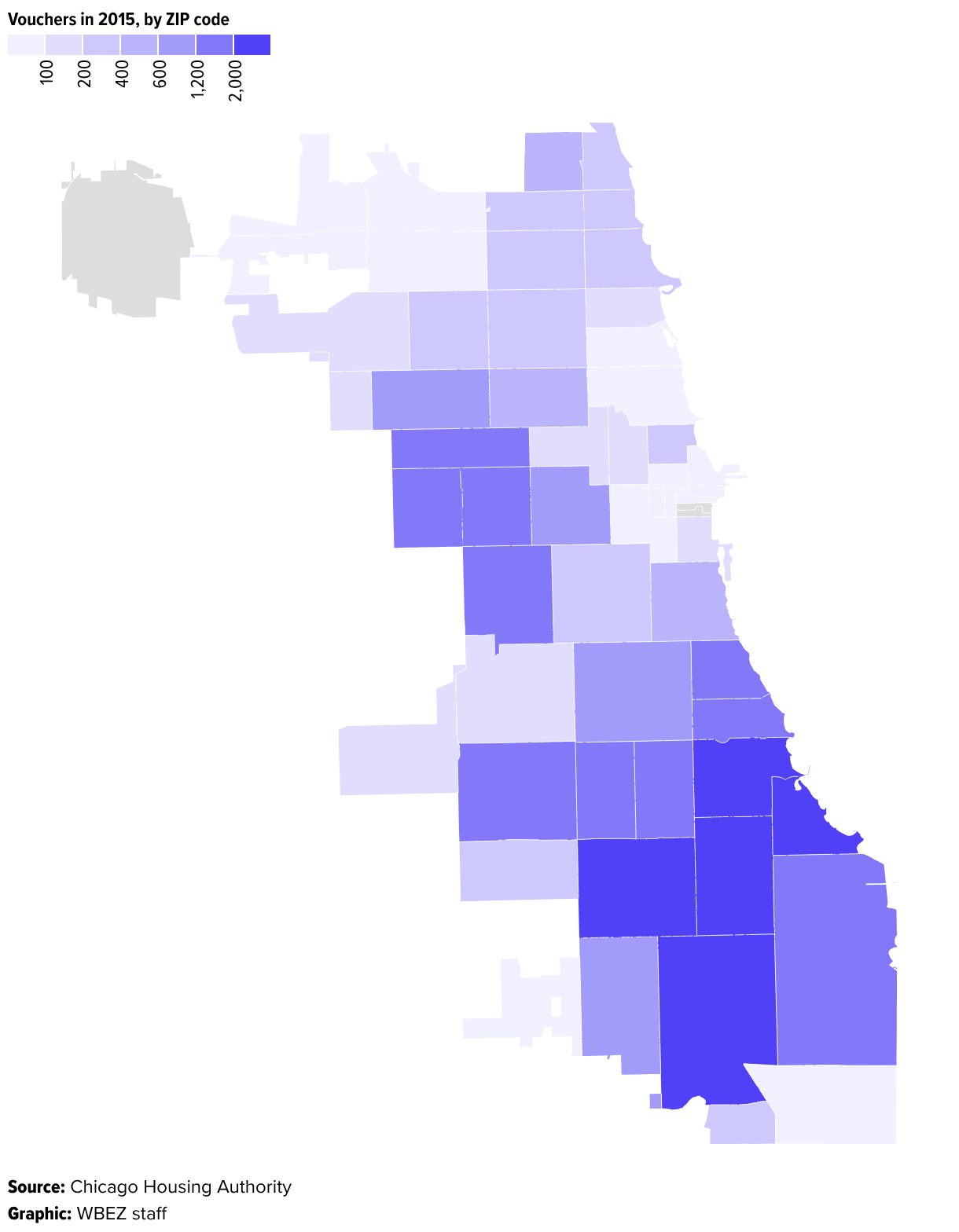
In Chicago, about 40,000 households have CHA housing choice vouchers with which they rent apartments from private landlords. Most of those voucher holders live in majority-Black neighborhoods on the city’s South and West sides, according to data from CHA. This has been the case for decades.
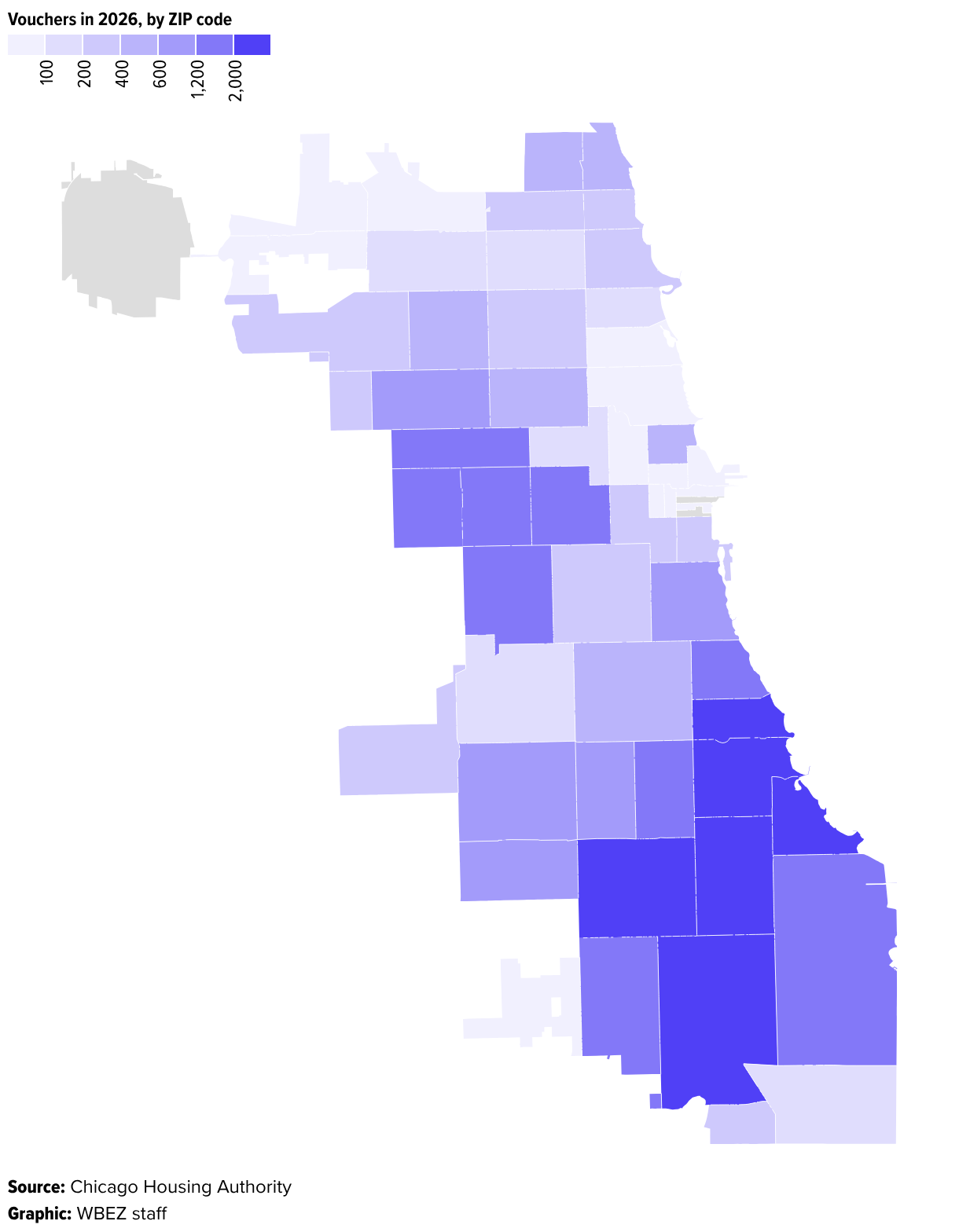
Furthermore, many end up having to return their vouchers because they cannot secure a home in the time frame they are given due to the shortage of affordable housing, credit checks, and discrimination from landlords based on source of income, DeLuca said.
That’s where mobility programs — if designed and implemented well — can help by “boosting the power of the voucher,” she said. While mobility is not the solution to poverty in disinvested parts of the city, they serve as a tool to ease low-income residents’ access to better neighborhoods they otherwise may not have been able to, she said.
DeLuca said the most successful mobility programs are high-touch and sensitive to families throughout the process. They provide support for the housing search and for conversations with landlords, help with paperwork, as well as funds for security deposits and application fees. Some programs do regular check-ins with participants and connect them to social services and support networks in their new neighborhoods.
“How the vouchers are administered and who the staff are administering them is vitally important because families need emotional support and they need some customized assistance,” she said.
After she moved to Schaumburg, Gloria Washington had regular meetings with the administrators of the court-mandated Gautreaux program — the Leadership Council for Metropolitan Open Communities. They connected her with Palatine Township, which provided help with bills and pointed her to resources like food pantries and clothing banks. They also gave her a list of nearby churches that donated cars and other items.
“They didn't throw us out there,” Washington said. “They gave us a list, [and said,] ‘Contact them, tell them what you need.’ ”
One housing mobility program in the state
Due to the success stories from Gautreaux, housing mobility programs saw a wave of expansion during the 1990s and 2000s. According to a report by the Poverty & Race Research Action Council, there are about 40 programs throughout the U.S., many of them clustered in the Northeast, New York state, in particular.
Even as recently as 2016, the Housing Authority of Cook County (HACC) established a Community Choice Program, “designed to help [voucher holders] transition out of racially and ethnically segregated areas of poverty and relocate into suburban Cook County ‘Areas of Opportunity.’ ” HACC discontinued the program in 2023 due to a lack of funds, according to a spokesperson.
Today, the only housing voucher mobility program in Illinois is through the CHA, and it moves about 200 to 400 families to higher-income, lower-crime Chicago neighborhoods each year. Applicants must be current housing voucher holders who currently don’t live in a mobility area and have dependents up to age 16.
Julie Brown, the lead counsel for the residents in the Gautreaux case, says mobility programs are considered boutique programs for which there is no dedicated funding from the federal government.
“There’s no money for mobility programs unless a housing authority figures out a way to find money because mobility is expensive,” she said. “It requires counselors. It requires [paying] higher rents, help with security deposits.”
Amid shrinking funds from the federal government for safety net programs, Brown said there’s a debate in the housing community: “Is it better to just provide as many vouchers as possible because we have a housing crisis, or is it better to take some of the vouchers and turn them into mobility money to help people move to mobility areas?”
She added that there needs to be the political will to do both. One bipartisan bill introduced in Congress this fall proposes the addition of 250,000 “housing mobility vouchers” for low-income families with young children.
Since CHA began tracking data in 2012, its Mobility Counseling Services Program has moved close to 5,000 families to opportunity areas, according to officials.
Catherine Johnson is executive director of Housing Choice Partners, which runs CHA’s mobility program. She was previously a housing counselor for the Gautreaux program. She says her organization matches voucher holders with Chicago Community Areas that have less than 20% poverty rate and below-median crime rates. Using those parameters, 42 of Chicago’s 77 community areas — from Albany Park and Ashburn to West Lawn and West Town — are considered “mobility areas.”
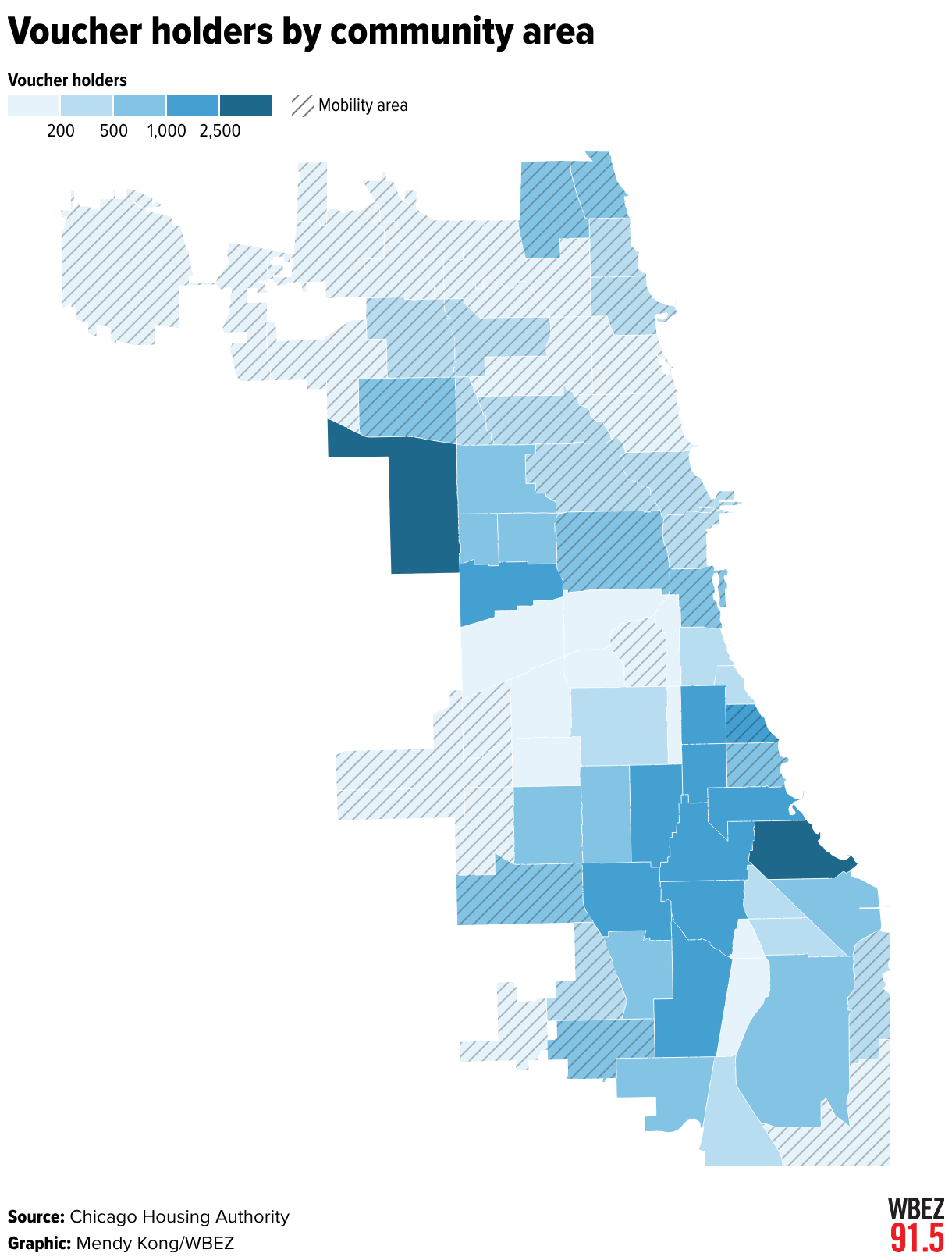
Unlike the Gautreaux program, which opened resource-rich suburbs up to families, CHA’s mobility program works within the city’s boundaries.
Some experts say this makes it harder for families to see the gains that families like Gloria Washington’s saw in the suburbs, with its higher-performing schools and increased resources. They say successful mobility programs in places like Baltimore and Seattle take a more regional approach.
But CHA says many families prefer to stay in the city, and that due to school choice, “families have access to high performing or specialized schools regardless of where they live.”
Furthermore, Johnson said participants seek mobility moves for various reasons — not just better economic outcomes for their children: Some want to live in safer neighborhoods, others want more amenities near their homes. Johnson also said there are varying reasons for choosing certain neighborhoods over others: staying close to family and other support systems, fear of racial prejudice in areas with few Black residents, proximity to a job. She also added that some families try out their new neighborhoods for a year and move back.
In the end, the goal is to provide participants with the best options so they can make their own choices for their families, Johnson said.
“We get a lot of praise … about how the program has helped them to make a move that they would not otherwise have made,” she said. “It has proven to be the answer for many, and it has proven to be what many families needed to help them to get to the next level.”
‘Better for my kids’
Crystal Glover knows firsthand what that feels like. After a bout of homelessness following a domestic dispute with her ex-partner that left second-degree burns on her face, the 30-year-old struggled for nearly a year to find an apartment with her housing voucher.
“I was going on apartments.com and Zillow and all that,” Glover said. “It’s just hard, and there’s so much scamming going on, so many application fees.”
She and her young children crashed with relatives and lived in and out of Holiday Inns and extended stay hotels. The kids would ask daily, “'When are we going home?' I had to say the same thing: I just kept saying ‘soon, soon, soon.’ ” Glover remembered.
One day, she was surfing the CHA website and found the mobility program.
“As soon as I applied, a lady emailed me right away,” Glover said. “Everything was swift. Everyone was friendly. Emails were getting responded to quickly.”
A two-bedroom unit in Morgan Park was available, and the landlord moved quickly. Glover said. The family moved in in April.
“The area is good,” she said, adding that the places where she previously lived lacked amenities and felt unsafe. “I have a lot of resources around me that’s walking distance: Walgreens, grocery stores, restaurants, parks. You don’t really see a lot of violence or rowdiness or people standing on the corners.”
Glover says having a home base has helped her focus on the future. She is planning to enroll in nursing school because she wants “better for [her] kids,” Glover said. “Just to be better than me, just to grow up with better education, continue college all the way until they can graduate, have a better job, so they won't have to struggle like I did.”
“Better for my kids” is the exact same phrase Gloria Washington used to describe why she moved four decades ago to a town she’d only heard of through car dealer commercials.
Washington said leaving Englewood for the northwest suburbs changed her life. Because of the resources available to her there, Washington said she was able to raise her children even after their father, who helped support them financially, passed away in a fire. She also enjoyed the diversity of the suburbs and being able to interact with people from other countries.
“When I leave this world, I will miss Schaumburg, and that is the truth,” Washington says. “If there is any afterlife, I will come back to Schaumburg. Schaumburg has been good to me.”
Ver nota original ↗
¿Querés un resumen rápido de esta noticia, hecho por nuestra IA?