San Diego city councilmember raises questions about police transparency on ICE
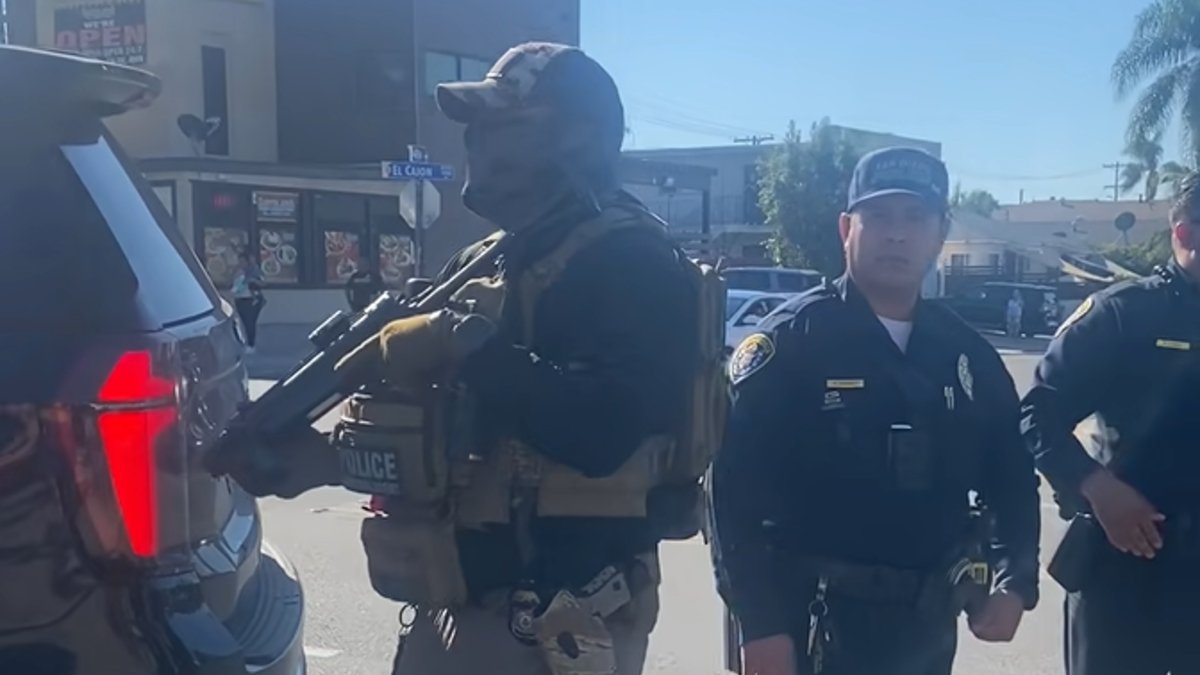
A San Diego city councilmember is raising questions about transparency when police respond to the scene of an ICE operation.
Councilmember Sean Elo-Rivera said Thursday that the San Diego Police Department is not reporting incidents in which officers respond to calls involving federal law enforcement, as required under municipal code.
For their part, San Diego police said they do notify all councilmembers and the mayor’s office of such responses, with procedures in place to meet those reporting requirements.
Elo-Rivera pointed to the city’s Due Process and Safety Ordinance, which the council passed in April, aimed at strengthening protections for residents amid heightened immigration enforcement.
The ordinance bars federal agents from non-public city property without a judicial warrant and further limits police involvement in federal enforcement based on a “protected personal characteristic,” which the measure defines as including immigration status.
California law since 2017 has prohibited the use of state and local resources to assist in federal immigration enforcement efforts, with limited exceptions. San Diego police have responded to incidents involving federal agents, with the department repeatedly saying their presence is only to assist with issues like crowd control. ICE operations across San Diego have regularly drawn protesters and sparked heated confrontations.
Elo-Rivera noted the Due Process and Safety Ordinance includes two provisions on reporting requirements that he alleged the department has not been following.
“If the San Diego Police Department responds to a call for service related to law enforcement activity by federal law enforcement agency personnel… where the alleged crime is a protected personal characteristic or protected personal activity, the Chief of Police shall issue a publicly available incident report within three business days of the response,” the ordinance reads. The second provision adds the chief “shall report such cooperation in writing to the City Council” as well.
Elo-Rivera said since the ordinance passed in April, the department has texted his office about four incidents, while some other councilmembers’ offices have received none.
“ICE on a daily basis is terrorizing our communities,” Elo-Rivera said. “And on a number of occasions, SDPD has been there, and we’ve asked repeatedly that the public get an explanation of what’s happening. And we’re not seeing that. And I’m tired of waiting.”
San Diego police said in a statement the department “has long been committed to keeping our communities and elected officials informed about our involvement in incidents involving federal immigration enforcement” and has “procedures in place to ensure we meet… notification requirements.”
“When SDPD responds to federal officials investigating an alleged crime involving a protected personal characteristic, including immigration status, we formally notify all City Council members and the Mayor’s Office,” SDPD’s statement continued. “We also contact federal officials to request the information required under the ordinance.”
Elo-Rivera’s criticism also came as he and San Diego Police Chief Scott Wahl remain locked in a political battle over San Diego’s Flock cameras. Elo-Rivera has pushed to remove the automated license plate readers over concerns about mass surveillance and data breaches. Wahl is vehemently opposed to their removal, often calling the cameras a “force multiplier” that help the understaffed department solve crimes.
“I’ve asked for 15 months for the chief to be more transparent about what is happening when SDPD is on the scene,” Elo-Rivera said.
“I’ve heard the chief repeatedly say he didn’t want to weigh in on this because it’s political, and then he’s chosen to weigh in on something that is very political,” he continued. “That tells me it’s not a belief that it’s not appropriate to weigh in on a political conversation. It’s not an inability to put together flashy graphics to make a point… It’s a choice. And I’m not okay with that choice.”
San Diego police did not respond to that criticism. Elo-Rivera said he’s considering amending the ordinance to address his concerns over the department’s reporting. As written, there is no enforcement mechanism in the code.
“This is part of what’s especially frustrating about this: We worked with the police department to write this in a way which gave them the flexibility that they said they needed to do their jobs,” Elo-Rivera said. “So they’re very, very understanding of what our intent was.”
In their statement, San Diego police said they communicate about other incidents and responses as well, more than required by the ordinance.
“We also recognize that community concerns about immigration enforcement go beyond what the ordinance covers,” SDPD’s statement reads. “In many cases, SDPD officers are called to maintain public safety when tensions arise between federal agents and community members, even when federal officials are not investigating an alleged crime involving a protected personal characteristic. While these incidents do not trigger the DPSO’s formal notification requirements, we still notify the affected Council office and the Mayor’s Office, so they know what happened and why officers are there.”
“Our commitment is to follow the law, keep people safe and make sure our communities and elected officials are informed,” SDPD said.
Ver nota original ↗
¿Querés un resumen rápido de esta noticia, hecho por nuestra IA?