Here's why an AI-generated campaign ad depicting Gov. Shapiro is allowed on the air in Pennsylvania
PHILADELPHIA (WPVI) -- Political attack ads have long been a feature of election campaigns, but the rise of artificial intelligence is giving candidates new ways to deliver their messages.
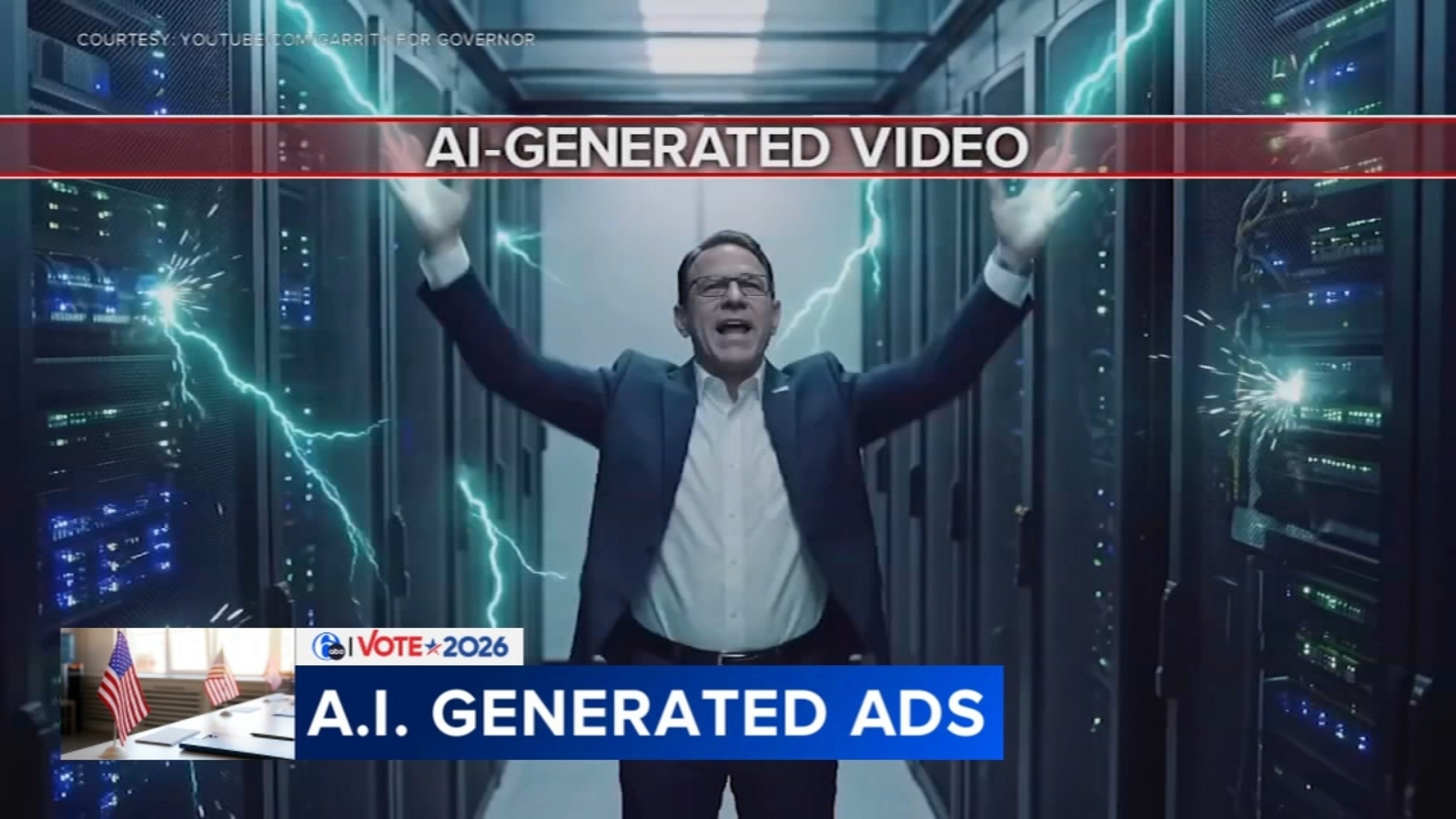
A campaign advertisement paid for by Pennsylvania treasurer and Republican gubernatorial candidate Stacey Garrity features an AI-generated version of Democratic Gov. Josh Shapiro, drawing criticism from viewers and raising questions about the use of artificial intelligence in political advertising.
The commercial opens with an AI-generated version of Shapiro saying, "Hello there! I'm Josh Shapiro. And I've been very busy," before going on to proudly admit to a variety of alleged scandals and claims.
Some viewers said they quickly recognized the ad as artificially generated.
"My initial gut reaction is - ew, AI, oh no," said Oona Darling of West Philadelphia.
"I didn't like it!" said Lillian Jones of North Philadelphia. Asked whether she could tell quickly that it was AI-generated, Jones replied, "Yes."
The ad discloses its use of artificial intelligence about 40 seconds into the spot, stating: "This ad was created with AI, thanks to big beautiful data centers."
"That seems like something that should not be legal," Darling said.
RELATED: Philadelphia officials step up Election Day security ahead of midterm elections
There are currently no Pennsylvania laws prohibiting the use of AI-generated content such as the ad.
Lindsay Hoffman, a communications professor at the University of Delaware, said the ad's obvious use of AI may help alert viewers to the technology and its growing capabilities.
"I think in some ways it might be useful for this to be a relatively obvious fake because it does alert people to the fact that these things do exist and that they will get better and better and better," Hoffman said.
Hoffman said legal frameworks often lag behind technological developments.
"I think that what will happen is - at a much slower pace, the laws will catch up to it, but by that time we're gonna be facing a different technological challenge," Hoffman said.
Pennsylvania Senator Lisa Boscola issued a memo in May announcing plans to introduce legislation that would prohibit AI deepfakes targeting candidates during election season. Delaware already has a similar law, making it illegal to distribute a deepfake of a candidate within 90 days of Election Day unless it is disclosed that the content was created using AI.
RELATED: Philadelphia highlights security measures ahead of Election Day
The advertisement has also prompted questions from viewers about why television stations air such content.
The reason, according to federal broadcasting rules, is that stations cannot censor or reject campaign advertisements paid for or sponsored by legally qualified candidates. If a third party were to submit the ad, stations might be able to reject it.
A spokesperson for Shapiro's campaign described the ad as "cheap" and "dishonest" in a statement to Axios.
Matt Beynon, a spokesperson for Garrity's campaign, provided a statement to Action News, saying: "It's telling that Josh Shapiro's only complaint with Treasurer Garrity's new ad is that he was depicted using AI. He has never refuted a single criticism made in the ad because he knows they're all completely accurate."
Hoffman said the growing use of artificial intelligence makes it even more important for voters to critically evaluate political messaging.
"People should already be skeptical when they're seeing political ads, but I think that this just makes it even more important," Hoffman said.
She cautioned against viewing AI as a uniquely transformative force in politics, arguing that new technologies have historically been used to influence public opinion and create confusion.
RELATED: What to know about election monitoring, ballot security ahead of midterms
"There's always going to be some new technology that's going to make it seem like this really changes the game, but I hesitate to make a claim like that," Hoffman said. "It's another in a long history of distractions, and no matter what the technology is - it almost doesn't matter what it is. People will find a way to manipulate it to change the conversation, to change the climate of opinion or to just cause chaos or havoc to make it difficult for people to truly understand what they're voting for."
Hoffman also said the technology could further disengage voters who are already disconnected from the political process.
"So what this might do is create an even bigger gap between the folks who are already sort of on the margins of elections and politics; it might just push them further away," Hoffman said.
Copyright © 2026 WPVI-TV. All Rights Reserved.
Ver nota original ↗
¿Querés un resumen rápido de esta noticia, hecho por nuestra IA?