Florida redistricting reshaped District 26, making it competitive for Democrats
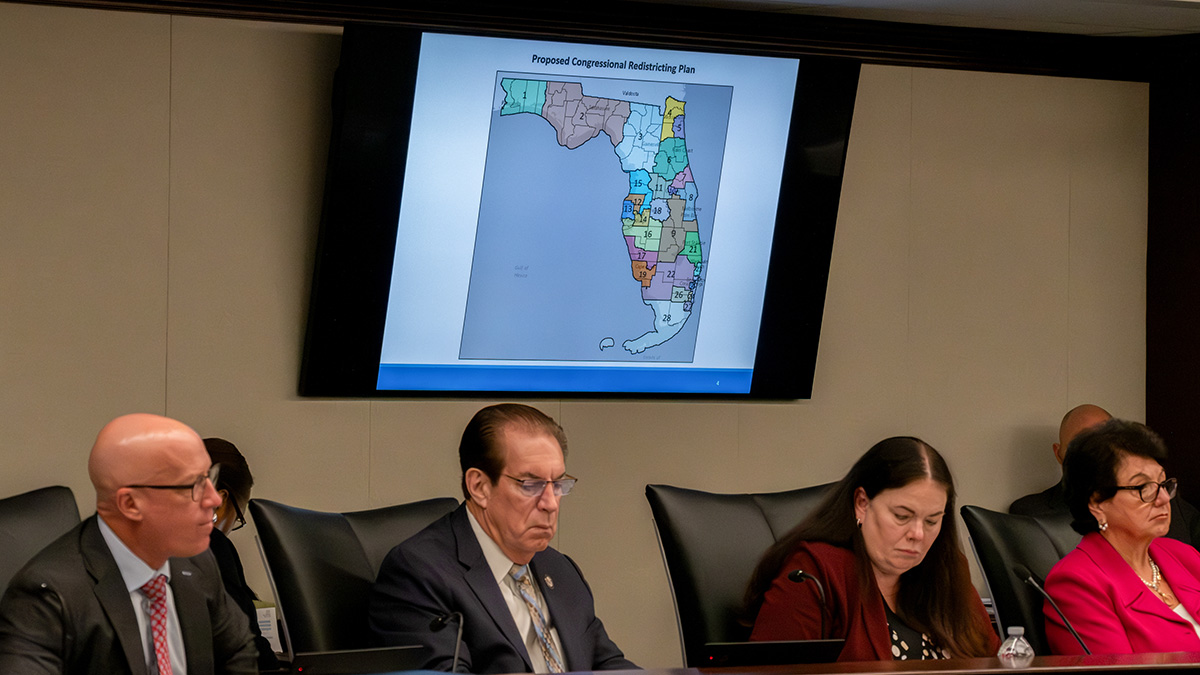
Republican Congressman Mario Diaz-Balart is locked in an unexpectedly close reelection battle after Florida's new congressional map added heavily Democratic portions of Broward County to his district.
Diaz-Balart is fighting to hold onto his seat in a congressional district that has historically been reliably Republican, highlighting the potentially unintended consequences of Florida's mid-decade redistricting.
As of Thursday afternoon, Diaz-Balart held a narrow lead over Democrat Nicole Locklin in Florida's 26th Congressional District. With an estimated 99% of the vote counted, Diaz-Balart had 49.9% to Locklin's 49.1%, according to NBC News.
The new District 26 stretches across parts of Miami-Dade and Broward counties. NBC News' analysis showed the district shifting nearly 18 percentage points toward Democrats compared with the 2024 presidential election.
NBC6 political analyst Alex Penelas said the redistricting effort made Diaz-Balart's race considerably more competitive.
“When you see someone like Mario Diaz-Balart, who's been in Congress for over 20 years, hold on to his seat by maybe 1,000 votes, it's specifically the result of this redistricting effort because reliably red areas were taken away from his district so that they could help Republicans in neighboring districts,” Penelas said.
Election night is over, but state law could force one local congressional race to head to a recount. Republican Congresswoman Maria Elvira Salazar is beating Democrat Elliot Rodriguez by about 1,100 votes, but the numbers are too tight to officially call a candidate a winner. NBC6's Christian Colón reports
Elections


Florida's mid-decade redistricting
Florida Gov. Ron DeSantis pushed the Republican-controlled Florida Legislature to redraw the state's congressional districts ahead of the 2026 midterm election, rather than waiting until the next census.
DeSantis called lawmakers into a special session and presented his proposed map on April 27. The Legislature approved the map two days later, and DeSantis signed it into law May 4.
Florida has 28 congressional districts. Before the new map, the state's congressional delegation consisted of 20 Republicans and eight Democrats. The new map was intended to put Republicans in a stronger position to capture as many as four Democratic-held seats.
But the election results so far show a more complicated picture.
As of Thursday afternoon, NBC News had called 17 Florida congressional races for Republicans and seven for Democrats, with four races still uncalled.
Emilio Gonzalez, a former Miami city manager, said the close District 26 result demonstrates the trade-offs involved in redrawing districts to make neighboring seats more favorable to Republicans.
“Look, the redistricting is obviously a product that's a sausage-making product in Tallahassee,” Gonzalez said. “I'm not sure that the Republican members of Congress were even consulted on a lot of these, but it shows in Mario's district. Mario would win his reelection in double digits.”
Democrats gain ground in Tallahassee
The shift wasn't limited to congressional races.
Republicans won Florida's major statewide contests, including the governor's race, but Democrats made significant gains in the Florida Legislature.
Republicans entered Election Day with an 86-34 advantage in the 120-member Florida House. As of Thursday afternoon, unofficial results showed Republicans with 70 seats and Democrats with 49, with one race still being counted. That would give Democrats their strongest representation in the chamber since 1996.
The results also mean Republicans will no longer hold the two-thirds supermajority they enjoyed in recent legislative sessions.
Lucia Baez-Geller, a newly elected state representative, said the larger Democratic caucus could change how business is conducted in Tallahassee.
“Now the majority can no longer simply ignore us. They have to come to the table,” Baez-Geller said. “We have a great opportunity now to demand greater accountability, transparency and legislation that is actually going to make lives better for people.”
Aubrey Jewett, a political science professor at the University of Central Florida, said the additional seats could give Democrats greater influence over the legislative process.
“With 50 members in the House, Democrats will potentially have more say on committees and will potentially have even a little bit more say in discussions on the floor of the House,” Jewett said.
Republicans are also poised to lose their supermajority in the Florida Senate. Early results showed Democrats gaining seats there as well.
Ver nota original ↗
¿Querés un resumen rápido de esta noticia, hecho por nuestra IA?