
The hole in our ozone layer got larger in 2026; biggest in a decade

Published November 5, 2026 7:16 PM CST

The hole in Earth's protective ozone layer grew to its largest size in a decade this year, with unusual weather conditions contributing to increased ozone depletion over Antarctica, according to scientists with NOAA and NASA.
But the ozone hole isn't an actual opening in Earth's atmosphere, NASA explains. Scientists use the term to describe a region over Antarctica where stratospheric ozone concentrations fall below 220 Dobson units."
Ozone hole got larger in 2026
Big picture view:
The 2026 ozone hole ranked as the seventh-largest in 48 years of monitoring, with an average area of approximately 9.6 million square miles between Sept. 7 and Oct. 13. That's more than twice the size of the United States.
Scientists said an unusually powerful polar vortex helped extend ozone depletion this season, allowing the hole to grow larger than it has in recent years. It reached its peak size on Sept. 18, covering approximately 10.5 million square miles. That’s about 90% as large as the largest ozone hole ever observed, which occurred on September 9, 2000.
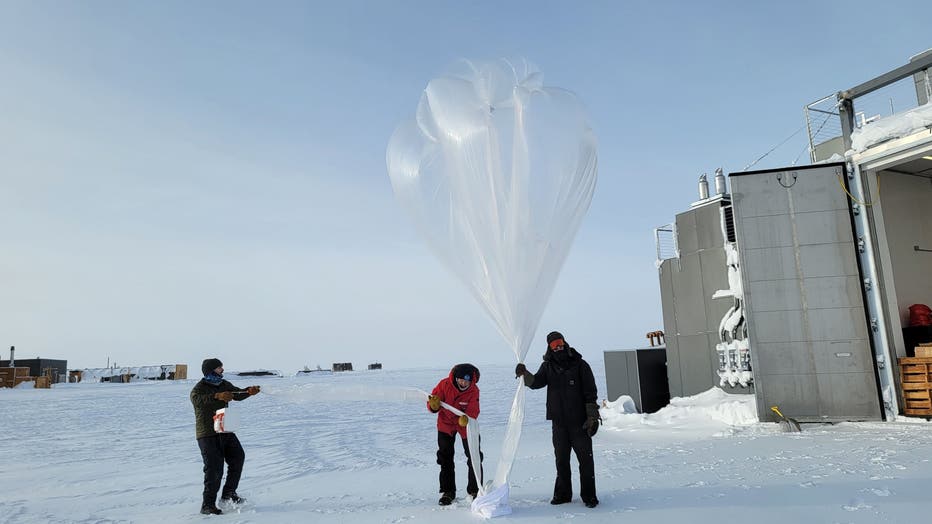
NOAA Corps LT Michael Doneghey, the South Pole observatory station lead, holds a weather balloon while NOAA Station Technician Luke Longren carries a package containing an ozonesonde — an airborne instrument that measures ozone levels — just prior to
Despite its size, scientists said the ozone hole would have been even larger if international efforts to reduce ozone-depleting chemicals had not been successful.
How NOAA scientists track ozone
Dig deeper:
According to NOAA, scientists continually track the amount of ozone in the stratosphere because it acts as Earth’s "sunscreen," helping shield life from harmful solar radiation. This is distinct from ground level ozone, which is an air pollutant commonly resulting from human activities.
"The annual ozone hole has been forming later in the season in recent years, which tells us the ozone layer is healing," Paul Newman, a senior scientist at the University of Maryland and longtime leader of NASA’s ozone research team at the agency’s Goddard Space Flight Center, said in a statement. "But an unusually powerful polar vortex has extended ozone depletion in the Antarctic this season, allowing the hole to grow to proportions we haven’t seen in a decade."
RELATED: Wildfires are reversing years of progress on US ozone pollution, study finds
"The 2026 ozone hole is large but could have been 1 to 2 million square miles (3.5 million square kilometers) larger if ozone-depleting substances were as prevalent in the atmosphere today as they were at their year 2000 peak," Newman said.
How does ozone loss occur?
The ozone depletion process begins when human-made compounds containing chlorine and bromine are released into the environment. Air currents carry the gases up into the stratosphere, where they’re broken down by ultraviolet radiation. The freed chlorine and bromine atoms interact with cloud particles in the Antarctic stratosphere to enable ozone destruction. The stratospheric polar vortex, a seasonal stream of wind encircling Antarctica, plays a key role by corralling the frigid air necessary to produce polar stratospheric clouds.
"The polar vortex was unusually large this year in part because planetary-scale weather systems that typically well up from the lower atmosphere and break up the vortex were especially weak in August and September," said Amy Butler, a research scientist at the NOAA Chemical Sciences Laboratory. "That weak wave action kept the strongest polar vortex winds further from the South Pole by several degrees of latitude, creating a larger area for conditions ideal for ozone depletion to occur."
Despite its relatively large area, the 2026 ozone hole was not as severe in terms of ozone depletion as some record-breaking holes in previous decades. NOAA measurements found that ozone concentrations directly above the South Pole fell to 105 Dobson units on October 17, compared with the record low of 92 Dobson units recorded in October 2006.
Scientists estimate the Antarctic ozone hole could recover by the 2070s as older ozone-depleting chemicals gradually leave the atmosphere.
The Source: The information for this story was provided by NOAA, NASA. This story was reported from Los Angeles.
Air and SpaceSevere WeatherU.S.Ver nota original ↗
¿Querés un resumen rápido de esta noticia, hecho por nuestra IA?


