
Betting is high stakes among young gamblers — even in a state where gambling is illegal

SALT LAKE CITY — "I do bet on football on occasion — just who's going to win or lose."
He's a high school student who asked KSL not to use his name, proclaiming his skill for predicting sports and political speeches.
"I haven't lost yet," he said.
He has no trouble betting on his phone as a minor, in a state where gambling is illegal. You won't find casinos in Utah, but almost everyone has a phone, making betting easier than ever.
Common Sense Media found that more than one-third of boys as young as 11 years old have engaged in sports-related gambling or betting apps, and nearly one-half by age 17.
"Just because gambling is illegal in Utah doesn't mean it doesn't happen," said Caleb Silverman, owner of an online recovery app called Bettrr. He says more than 2,200 Utahns called his gambling hotline last year, up 28% from the year before.
"Utahns are the fourth-highest represented state, unfortunately," he said.
If you think Utah lawmakers are fine with these numbers, don't bet on it. Utah's Attorney General Derek Brown last month filed criminal charges against prediction market company Kalshi and its co-owners for allegedly violating the state's anti-gambling laws.
The lawsuit claims there is substantial, ongoing harm caused by gambling, and new research from Brigham Young University backs up those concerns.
"We're able to say that betting caused people to change investing behavior," Professor Mark Johnson said.
Johnson's research tracked household savings and spending in states that legalized betting. They found that investing declined as much as 50% among frequent bettors, many of whom can least afford it.
"Particularly for those households that were most vulnerable, the households that had the lowest savings, that we saw the biggest increases in debt amounts," Johnson said.
Case in point: an estimated 60% of college students gamble, according to Jerry Basford at the University of Utah.
Basford set up the university's Financial Wellness Center, initially to advise on tuition issues. He never thought he'd be counseling students on gambling debts.
"They don't know they have a problem with the finances because, unlike loans (and) credit cards, you don't know what your monthly payment is until you get the bill," Basford said.
He had seen students who become so obsessed with gambling that they start to miss class.
These serious consequences are now taught in Utah high schools. Financial literacy is a required class, and gambling was part of the day's lesson at Skyridge High School.
Teacher Gig Griffith focuses on sound financial principles. But he sees that the odds are against him as he asks kids to raise their hands if they or their friends have tried gambling, or "predicting," as many teens prefer to call it.
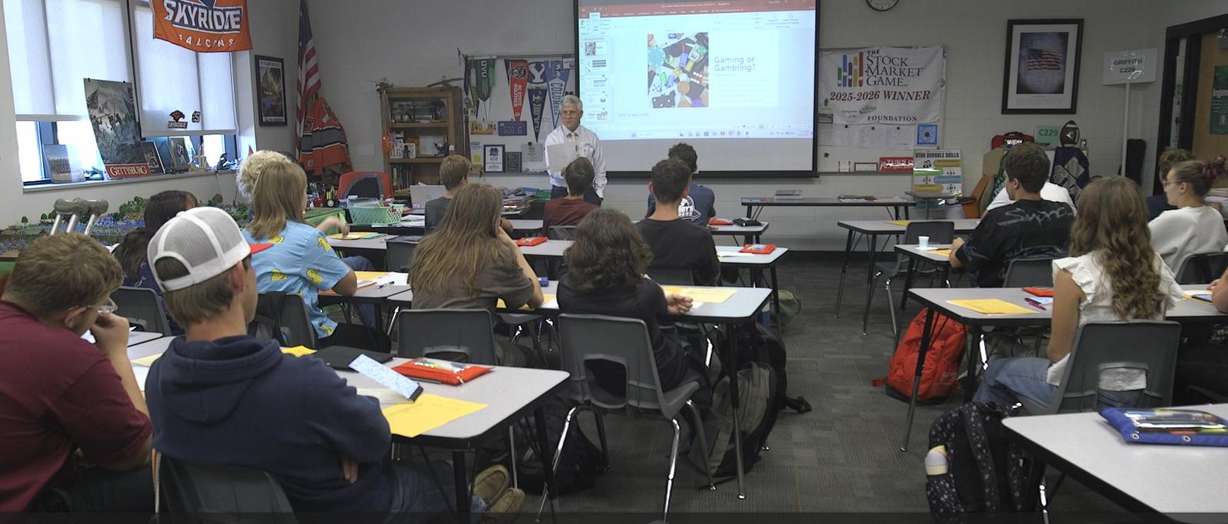
"They're hearing, 'Wow, you can get rich quicker if you have this online account and you trade in the right way; you don't need these other career paths,'" Griffith said.
Even the students were surprised at how easy companies make it by requiring no verification and offering incentive money.
"The first five bucks you spend, you get 45 bucks in return, and my friend was like, 'Hey, why don't we try this? I think it could be cool,'" one junior said.
"It's hard to avoid. You get ads for it, like, almost every day," a girl in the class added.
Griffith tries to impress on his students the importance of financial literacy, and that after driver's ed, it might be the most used class in their adult lives.
Johnson has the same concerns with his college finance students, particularly young men, who think their knowledge of sports will lead to profitable betting.
"I'm surprised at how overconfident they are with respect to their sports betting. They say, 'This is something I'm really good at. I think it can win consistently.' And the reality is, you just can't. You're going to lose to the house 98% of the time."
He hopes more young people will learn that reality and find more productive ways to use their time and money.
And Basford hopes more parents will talk with their young kids, since they are increasingly the target.
"They're trying to get these kids who are watching with their parents, sporting events, and seeing these opportunities to gamble," he said.
In the meantime, the legal fight to restrict gambling here will continue. Kalshi and its executives have been ordered to appear in Salt Lake City's 3rd District Court next month.
The Key Takeaways for this article were generated with the assistance of large language models and reviewed by our editorial team. The article, itself, is solely human-written.
Ver nota original ↗
¿Querés un resumen rápido de esta noticia, hecho por nuestra IA?


