
Honoring Huerta includes protecting, removing barriers for naturalized citizens
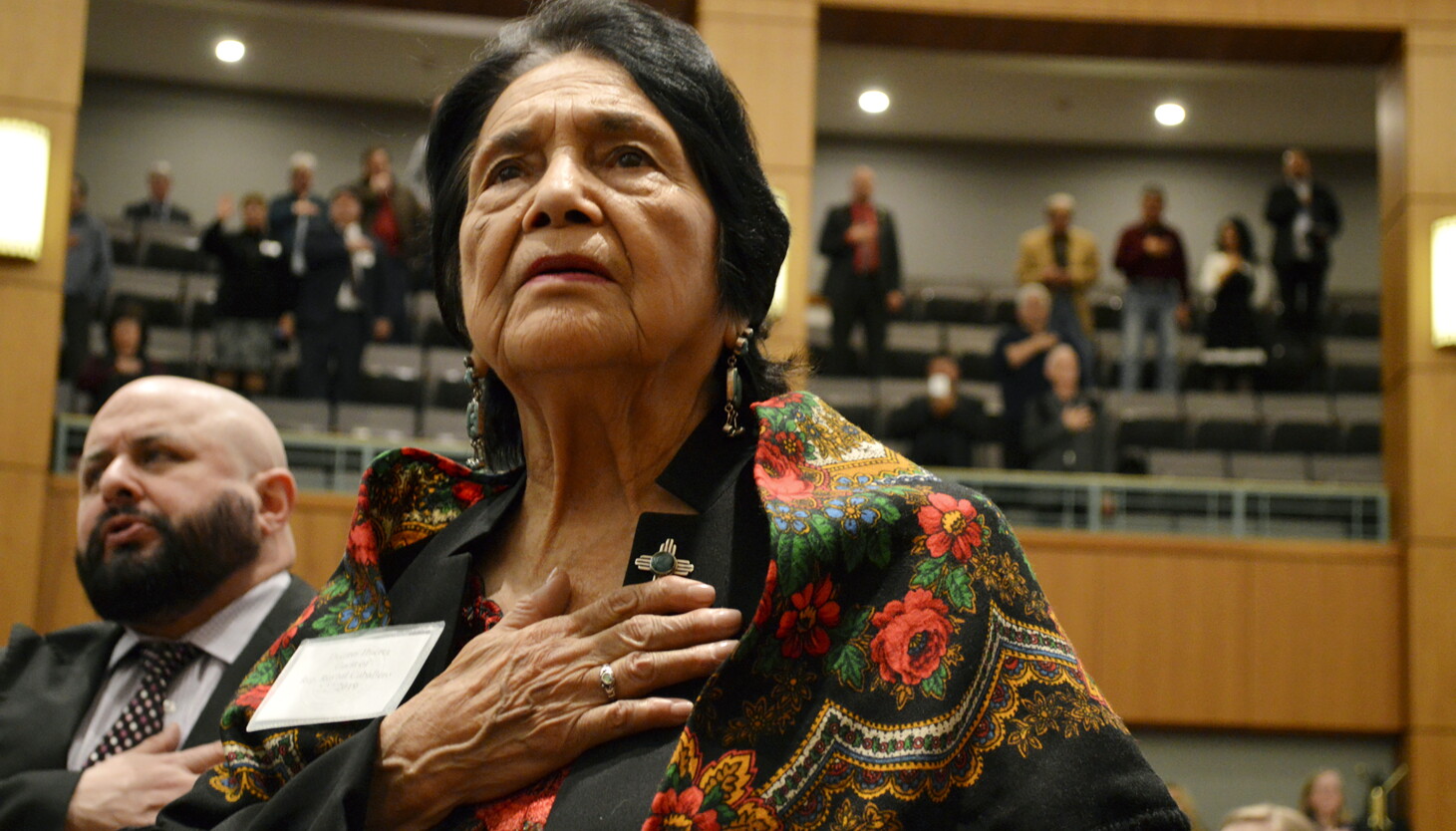
The passing of civil rights icon Dolores Huerta and the results of Tuesday’s election — a resounding rejection of the administration’s corruption, cruelty and billionaire-first agenda — are a powerful reminder of what can happen when voters stand up to protect the promise of America.
Huerta dedicated her life to a transformative belief: Every person deserves dignity, and dignity should never require extraordinary sacrifice. She organized farm workers who labored for poverty-level wages, demanding that the people who sustain our economy receive a voice, fair treatment and the opportunity to build secure futures. Huerta’s work reminds us that a stronger democracy depends on everyone’s ability to participate.
As we absorb Tuesday's election outcome, ushering in divided government and a new test of lawmakers’ commitment to working people and immigrant communities, that vision feels especially urgent. While ballots have been cast, the actual work of democratic inclusion remains and is more vital than ever.
A recent poll by the National Partnership for New Americans reveals a disconnect between naturalized citizens’ commitment to our democracy and their concerns about their place in it. While 90% reported being deeply committed to voting, more than half reported feeling less secure in their citizenship — a status they worked hard to earn. The same survey showed that 78% cited grocery and food prices as their top priority, with 44% reporting that household finances worsened over the past year.
These findings in tandem with the overwhelming midterm election results tell a larger story about the state of our union. Naturalized citizens are actively participating in our democracy while shouldering the same pressures facing households nationwide. But as Huerta's work showed, people cannot fully engage in civic life when they are struggling to afford necessities, facing barriers to citizenship or feeling insecure about the rights they have already earned.
Honoring Huerta means protecting the rights of naturalized citizens, eliminating the barriers that prevent eligible immigrants from becoming citizens and investing in the community organizations that help newcomers participate fully in civic life.
Those now holding power must honor Huerta’s legacy, recognizing that our democracy depends on the participation, protection and dignity of all its citizens. Her legacy calls us to keep organizing, opening doors and building a country where dignity is not conditional and belonging is not in doubt.
Nicole Melaku, executive director, National Partnership for New Americans
Give us your take
Send letters to the editor to [email protected]. To be considered for publication, letters must include your full name, your neighborhood or hometown and a phone number for verification purposes. Letters should be a maximum of approximately 375 words.
Playing into Americans’ fantasies
The only action most our nation, myself included, took under the advice of our felon president was “pretend I’m on the ballot.” We finally did. Thank you America for waking up!
Tony Prevolos, Bonita Springs,Florida
Props to perioperative nurses
There are 139,000 registered nurses employed in Illinois — approximately 94,000 work in the Chicago area. Perioperative nurses are among this dedicated workforce. Perioperative Nurses Week, which runs Nov. 8-14, provides an opportunity to recognize the nurses who care for patients before, during and after surgery.
Every day, patients take a big leap of faith when they enter an operating room and place their trust in a surgical team to safely care for them and return them to their loved ones.
Perioperative nurses provide critical clinical and technical care while serving as patient advocates. They anticipate risks, ensure equipment is available and functioning, maintain aseptic practices and participate in safety measures designed to prevent errors. When patients are under anesthesia and cannot speak for themselves, the perioperative nurse remains their voice.
Patients may not realize how many interactions surrounding surgery are centered on their safety. When a nurse asks you to confirm your name, procedure or surgical site — sometimes more than once — it's intentional. Before a procedure begins, perioperative nurses are key as the surgical team pauses for a “timeout” to confirm critical information and ensure that everyone is focused.
Perioperative nursing is about reassuring frightened patients, preserving dignity, noticing subtle changes, communicating during procedures and remaining attentive when patients can't. Nurses also keep families informed as they wait for their loved one's surgery to end.
Perioperative nurses also support one another in maintaining these skills. Nationally, the Association of periOperativeRegistered Nurses develops standards and guidelines, while 11 of its chapters across Illinois provide opportunities for education, mentorship, networking and professional growth.
Patients may not remember the nurse who cared for them in the operating room or see the countless safety checks and advocacy efforts performed on their behalf. Yet perioperative nurses are there assessing, anticipating, advocating and protecting patients during some of the patients' most vulnerable moments.
This Perioperative Nurses Week, we invite our communities and healthcare leaders to recognize these often unseen workers. To perioperative nurses across Illinois: Thank you for your expertise, vigilance, compassion and unwavering commitment to every patient you serve.
Maria Carmencita Duffy, chair, Illinois Council of periOperative Registered Nurses
Rebecca Vortman,national secretary, Association of periOperative Registered Nurses, and clinical associate professor, University of Illinois Chicago, College of Nursing
William “Bill” Duffy, former national president, Association of periOperative Registered Nurses
Funding faith-based schools
Illinoisans need to pay attention to a recent New York Times Magazine essay by "The 1619 Project" creator Nikole Hannah-Jones. After sending her daughter to an underperforming, high-poverty school a decade ago, Hannah-Jones expressed regret in her piece. Hannah-Jones deserves credit because she made a sacrifice to support her deeply held principles. And now in spite of her ideals about education, she's telling more of the unflattering truth about many urban public schools: chronically absent teachers, ungraded homework and tests and disruptive behavior.
My wife and I have faced the same dilemma as Hannah-Jones. We wanted our five children to receive a great education, but we did not want to abandon our less-fortunate neighbors. With many others, we founded a school on the West Side, reserving half of the seats for children living in poverty.
The Field School is now thriving in Austin with 330 students. Our student body is roughly one-third Black, one-third Latino and one-third white. Our academic proficiency matches that of Illinois’ top-ranked, wealthy schools. What I am concerned about as a father, however, is who my children and their classmates are becoming. Character, virtue and shaping our souls through history, music, art and athletics — these matter just as much as test scores.
But here’s the catch: because The Field School teaches from a Christian perspective, we're denied public funding. Even though we often get four times as many applications as open seats, we can only grow through charitable giving. Hannah-Jones and her allies have, for decades, advocated for a K-12 education system that's unlike early childhood education, higher education and healthcare, where public money funds follow each individual into whichever institution they choose. This difference sharply restricts the ability of faith-based schools to serve the urban poor.
With the new Federal Scholarship Tax Credit coming into effect on Jan. 1, Illinois doesn't need to change any laws or lose any revenue to support its religious schools serving children in poverty. All it needs to do is allow money donated to student scholars to stay in the state. Gov. JB Pritzker should change course and do the right thing by accepting this money, allowing more families to have the same educational choices Hannah-Jones has.
Jeremy Mann, founder, The Field School
Opposing school vouchers as a faith leader
As a Baptist pastor, many might expect me to support a voucher program that helps students attend private Christian schools. Instead, I oppose it for the following three reasons.
First, the tax-credit scholarship program uses public revenue to subsidize private education. Taxpayers who donate to scholarship-granting organizations receive dollar-for-dollar federal tax credits. This diverts funds away from public schools, which educate 9 out of 10 Illinois students, and already face a $6.8 billion funding gap. We should fully fund schools serving most of our children.
The U.S. Treasury Department’s regulations make this more urgent. States that opt in must administer vouchers but cannot narrow requirements on scholarship organizations and can't exclusively designate funds for public schools. Illinois can't set its own safeguards for accountability, academic quality or civil rights.
Secondly, who benefits? Research shows voucher programs serve students already attending private schools. Private schools can choose their students and are not subject to civil rights and disability protections that govern public schools. So students who receive tax-subsidized vouchers may not be protected from discrimination on the basis of LGBTQ+ status, religion, language needs or disability. Students should not have to trade their rights for a good education.
Third, my Baptist tradition asks what happens to freedom of conscience when the government funds religious education? Some voucher schools consider religious affiliation in admissions and require students to align with religious principles. A family could receive a scholarship yet be turned away from a school because of their beliefs. Even if a child isn’t forced to believe, what freedom exists when belonging at school may depend on believing the “right” things?
Ultimately, I'm not against faith in education. I'm for a faith that does not depend on state funding or endorsements to thrive. I am for faith that is freely chosen, not coerced, and that seeks the flourishing of every child. As Illinois leaders consider whether to participate, please ask: Will we protect our children’s freedom of conscience and strengthen the public institutions that serve all of us, not just the select few?
The Rev. Karen Atkins, executive pastor and director, Immanuel Church Unusual Chicago
Give full story on evangelical Christianity
I was glad to learn about Julie Roys and Roys Report in Robert Herguth's recent Sun-Times story. Thank God, there are journalists devoted to exposing sexual abuse by Christian leaders. I know how insidious this is. My parents and I trusted the man who preyed on me and sexually abused me when I was a teenager because he and his wife were youth ministers.
It's godly work to shine a light on these abusive creeps and hold them accountable. I hope Roys' reporting will keep some would-be victims safe and help sexual abuse survivors. It’s a long, tough road toward healing. Every bit of truth helps.
I also hope Roys keeps growing in her "sacred calling," beyond her concern with sexual abuse, as some of her positions perpetuate problems in the churches she covers. I cringed while reading her Christian journalism advocacy paper about her opposition to "the LGBTQ agenda" and the instruction of Wheaton College students in social justice. Yikes.
I hope Roys realizes that we Christians, our institutions, and our interpretations of Scripture are limited. While she is a good watchdog in exposing sexual abuse in the evangelical church. I'd caution her engagement with other Christian fundamentalists in their knee-jerk litmus tests of what is wrong or right. I encourage her to investigate the context for fundamentalist positions that can cause harm. For starters, she can read Kristin Kobes Du Mez's book "Live Laugh Love: The Secret History of White Christian Women and the World They Made," which exposes how white, American evangelical patriarchal culture benefits some while keeping others down.
May all professing Christians serve God by telling the truth and loving their neighbors.
Sharon Schmidt, Portage Park
Spouting off
When it comes to dumping raw sewage into our rivers, the leaders of our region lack the courage to make the one change needed to stop this. The change is to make disconnection of downspouts from homes mandatory by law.
From the city of Chicago’s website, the city “actively encourages homeowners to disconnect their downspouts from the sewer system and direct the water instead to their yards or gardens.” The time for active encouragement needs to end and the time for statutory change and enforcement has arrived. The leaders in the city as well as the surrounding suburbs who are connected to the system need to step up.
Don Anderson, Oak Park
Ver nota original ↗
¿Querés un resumen rápido de esta noticia, hecho por nuestra IA?


