From family ranch to Texas Capitol: Clayton Tucker outlines plans for agriculture, school meals and food costs
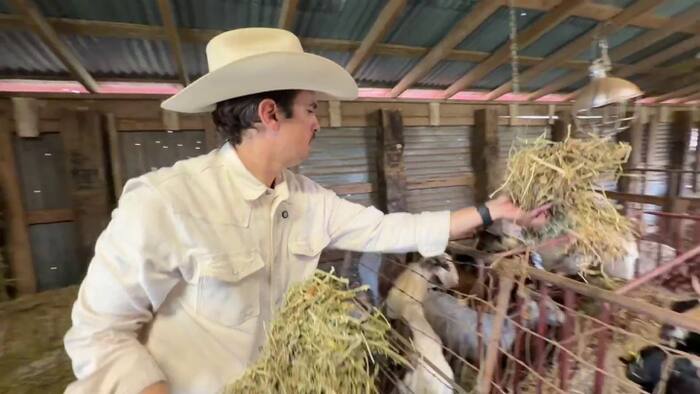
On a family ranch just outside Lampasas, Clayton Tucker is surrounded by cows, goats and the land that has been part of his family for nearly 60 years.
It’s a place where the newly elected Texas agriculture commissioner feels most at home.
“This ranch has been in our family for almost six decades,” Tucker said while walking through the property and feeding his animals.
But life is about to change for the 35-year-old rancher.
Tucker made political history this month, becoming the first Democrat elected to lead the Texas Department of Agriculture since 1986.
And while his new title may bring to mind farmers, cattle and ranchland, the responsibilities of the office reach far beyond rural Texas.
From school meals and food access to agricultural production and rural development, the department oversees programs that affect millions of Texans, including families in San Antonio.
During an interview with KSAT at his family’s ranch, Tucker discussed the challenges facing Texas agriculture, his plans to address food affordability and why he believes the state’s food system needs major changes.
A rancher who never planned to enter politics
Tucker describes himself as a rancher who has worked in agricultural policy, community gardening and the farmers union.
He said he never intended to run for political office.
“I never intended to do it. In many ways, I kind of got voluntold,” Tucker said.
But watching farmers struggle financially and family operations disappear convinced him to enter the race.
“Just seeing what’s going on with our food system, our farm system, farmers going out of business, farmers going broke,” Tucker said.
He joked that after deciding to run, he became “the dog that caught the bumper.”
Now, Tucker is preparing to lead a state agency responsible for supporting an industry he says is increasingly difficult to survive in.
Walking through his family’s roughly 300-acre ranch, Tucker pointed to the rising costs of land, equipment, diesel and fertilizer.
“As you can tell, this is not a rich man’s ranch,” he said. “I call this a working ranch, or we’re not quite broke, but we’re close. But that’s how most ranchers are.”
Tucker said the cost of entering agriculture has become so expensive that he doubts he could afford to become a rancher today if he had not grown up in a family already involved in the industry.
He also described the financial uncertainty farmers face when severe weather can destroy crops or livestock.
“You could do everything right. And then one bad storm wipes you out for the entire year,” Tucker said.
He believes those challenges are among the reasons younger generations are walking away from farming and ranching.
What his plans mean for South Texas farmers and ranchers
For farmers and ranchers in communities such as Uvalde, Poth, Floresville and La Vernia, drought, rising operating costs and threats to agricultural land remain major concerns.
Tucker said protecting family operations will be a priority.
One of his proposals involves working with state lawmakers on a supplemental Texas farm bill that could provide additional agricultural assistance.
He also wants Congress to approve a new federal farm bill.
“We’ll be working with Congress to get a new farm bill passed. We have to.” Tucker said. “That is the single greatest thing you can do for farmers right now.”
Tucker said a state-level proposal could potentially provide additional funding for farmers while also supporting food assistance programs such as the Supplemental Nutrition Assistance Program, commonly known as SNAP, and the Special Supplemental Nutrition Program for Women, Infants and Children, or WIC.
Such a proposal would require legislative approval and funding.
Tucker also wants to make it easier for farmers to sell products locally by reviewing regulations he believes create unnecessary barriers for smaller agricultural operations.
He specifically mentioned rules surrounding egg grading and said he would support allowing more locally produced eggs to be sold with appropriate labeling.
He also wants stronger standards for food labels, including claims such as “pasture raised” and “antibiotic free.”
A push for free school meals in Texas
One of Tucker’s priorities has little to do with cattle or ranchland.
The Texas Department of Agriculture administers federal school nutrition programs, making the commissioner an important figure in discussions about student hunger.
It’s an issue affecting families in San Antonio, where changes to school meal programs have raised concerns about access to free breakfast and lunch for thousands of students.
During the interview, KSAT asked Tucker about the thousands of students affected by changes to meal programs at a San Antonio-area school district.
Tucker, who previously worked as a teacher, said he believes every child should have access to nutritious meals without having to pay.
“Every kid should have food, whole food, organic food, and it shouldn’t cost them anything,” Tucker said. “We shouldn’t be charging them or forcing them to eat ham and cheese sandwiches. Like school meals should be free.”
He also wants schools to incorporate community gardens, allowing students to learn how to grow food and share those skills with their families.
Tucker described his experience helping establish a community gardening program in Killeen that worked with students experiencing behavioral and academic challenges.
He said he witnessed improvements among students who participated.
Beyond expanding access to meals, Tucker wants more food served in Texas public schools to come from Texas farmers and ranchers.
He said locally produced food could help support the state’s agricultural economy while giving students access to fresher ingredients.
However, expanding free school meals statewide would require additional funding and cooperation from lawmakers.
Tucker acknowledged that much of the money would need to come from state or federal sources.
“We’ll be working up there with the farm bill and the USDA for more funding from them because in our country, in our state, no kid should be hungry,” he said.
Why Tucker believes grocery prices are too high
Rising grocery costs are another issue Tucker says he wants to address.
During the interview, KSAT asked how he plans to help families who are spending hundreds of dollars each week on groceries.
Tucker said farmers and consumers are both struggling financially, even as food prices remain high.
“Buying a pound of beef shouldn’t force you to go broke,” Tucker said.
He blamed what he described as excessive corporate concentration in the food and agricultural industries.
Using an hourglass analogy, Tucker described farmers and ranchers at one end, consumers at the other and a small number of large companies controlling much of the processing and distribution in between.
He argued that this concentration gives large corporations too much influence over the prices farmers receive and consumers pay.
Tucker said he wants to work with the Texas attorney general to challenge what he believes are anticompetitive practices.
He also supports expanding locally owned processing facilities and agricultural cooperatives.
“If we can break those guys up and make our food truly local again and produced and processed locally, particularly by co-ops, that will make food affordable and actually safer,” Tucker said.
His criticism of large agricultural companies reflects his broader belief that the current system puts smaller producers at a disadvantage.
“With a system rigged like this, you can’t win,” he said.
Concerns about data centers and Texas water supplies
Tucker also raised concerns about the rapid expansion of data centers and their potential impact on water supplies and agricultural land.
He said he is particularly worried about projects that could increase competition for water in communities already dealing with drought and population growth.
“I’m not going to be treating our people as sacrificial lambs for someone else’s economic development,” Tucker said.
He argued that large development projects should benefit the communities where they are built rather than place additional burdens on residents.
Tucker pointed to concerns about water use in Central Texas and the Corpus Christi area.
“I’m gonna be a little less compromising with data centers,” he said. “I am very sensitive when anything takes my water and my land.”
While the Texas Department of Agriculture does not have broad authority to approve or reject data center developments, Tucker said he intends to advocate for policies that protect agricultural resources.
For South Texas communities, where water availability is already a concern, Tucker said protecting those resources must remain a priority.
The cost of keeping a family ranch alive
Back at his family’s ranch, Tucker said the rising cost of equipment is another example of the challenges facing agricultural producers.
He criticized restrictions on farmers’ ability to repair certain equipment themselves, particularly tractors that rely on proprietary software and diagnostic systems.
Tucker argued that farmers should have greater access to the tools and information needed to repair machinery they own.
He described a fellow farmer facing expensive tractor repairs and said restrictions on equipment servicing can create additional financial pressure for small operations.
For Tucker, those costs are part of a larger problem that threatens the future of family farming.
He said agriculture was once a more financially stable way of life, but rising debt and operating expenses have made it increasingly difficult for families to maintain their land.
Tucker, a third-generation member of his family’s ranching operation, said he worries about the future of farms passed down through generations.
“That’s why we need to protect our farms and our ranches,” he said.
A Democrat taking over a traditionally Republican office
Tucker’s election represents a significant political shift in Texas.
But Tucker said he does not want party affiliation to define his leadership.
He said outgoing Agriculture Commissioner Sid Miller, a Republican, encouraged him to do what is best for Texas.
“Commissioner Miller and I come from different parties, different backgrounds,” Tucker said.
Tucker described himself as a Democratic populist and said he intends to prioritize the needs of Texans regardless of political affiliation.
He said the issues facing farmers, ranchers and families are not limited to one political party or geographic region.
“We all eat food. We all drink water. We all need shelter. We all have families. We all care for our communities,” Tucker said. “It’s not about looking left and right, it’s about looking up and down.”
From Lampasas to the state Capitol
For now, Tucker is still spending time on the ranch where he grew up, caring for the cattle and goats that have become part of his daily routine.
He said his family, which generally prefers to stay out of the spotlight, is adjusting to the attention that comes with his election.
But Tucker believes his experience on the ranch gives him an understanding of the challenges facing agricultural families.
As he prepares to take office, he says his goal is to make food more affordable, protect natural resources and help keep family farms in business.
“At the end of the day, all Texans really want the same thing,” Tucker said. “Affordable food, healthy land, and clean water.”
For the 35-year-old rancher preparing to take on one of Texas’ statewide offices, he says those priorities are what unite urban and rural communities.
“Because it’s not about what divides us, it’s about what unites us,” Tucker said. “And food, water, and land unite us.”
Ver nota original ↗
¿Querés un resumen rápido de esta noticia, hecho por nuestra IA?