SAWS appealing to public to avoid dumping grease from holiday cooking down the drain
With visions of turkey and stuffing on the horizon, the San Antonio Water System is encouraging people to be a bit more careful when preparing those holiday feasts.
Specifically, SAWS is urging people not to pour grease and oil that comes from cooking those meals into their drains.
“We tend to cook a lot richer foods and maybe we do things like fry a turkey,” said Lilliana Gonzalez, a senior communications specialist with SAWS. “Downstream, (the grease) will end up in the system and, quick reminder, the SAWS system is also your system.”
Gonzalez said once it leaves the drains in people’s homes, grease and oil get trapped in sewer pipes.
Often, it becomes entangled with other items, leading to one big clog.
She emphasized that the trouble is not only triggered by cooking oil or grease but by other things containing fat which tend to solidify when cooled.
“Maybe ice cream or salad dressings or whole milk,” she said.
Instead of pouring them down the drain, Gonzalez said those items should be placed in a trash can.
The same action, she said, should be taken when disposing of bathroom wipes, even if they claim to be disposable.
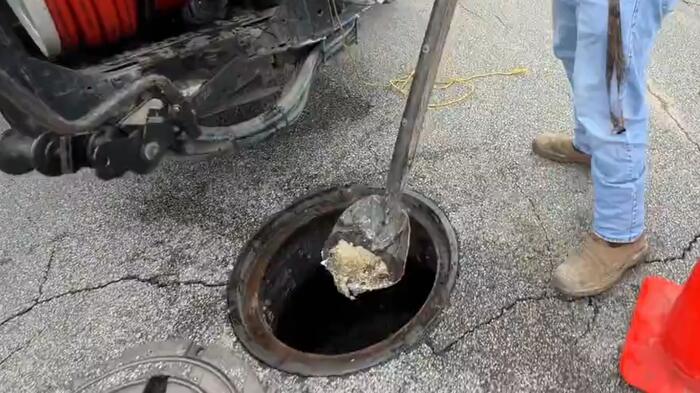
With the help of a SAWS field crew Wednesday morning, Gonzalez showed an example of the problem in the real world.
While one crew member used a robotic camera to explore the sewer line, others at the opposite end of the street used a truck, equipped with a high-pressure water hose and vacuum, to clear out any clogs.
“This is all the grease buildup that they’re putting into the sewer main,” said the camera operator, Jonathan Butler, as he pointed out trouble spots on a TV monitor.
The crew at the other end of the street managed to pull out clumps of wipes from the pipes, covered in dirt and grease.
Gonzalez called it “gross,” saying that it, “makes for great visuals, but it is disgusting.”
Even more than that, she said the problem can be costly.
“If we make it somebody else’s problem by pushing it down the drain, it’s still your problem because it costs all of our ratepayers,” she said.
Gonzalez said SAWS crews regularly clean and maintain the more then 6,600 miles of sewer lines across the city.
If they did not do that, she said, there would likely be frequent sewer spills.
Read also:
Ver nota original ↗
¿Querés un resumen rápido de esta noticia, hecho por nuestra IA?