
Opponents fear Louisiana International Terminal will transform Violet, and not for the better
VIOLET, La. (WVUE) - In the cargo industry, clearance can be everything.
Thousands of vehicles cross the Crescent City Connection bridge in metro New Orleans every day. But below, on the Mississippi River, only certain-sized vessels can safely clear the bridge, because of a height restriction of roughly 166 feet.
Beth Branch, president and CEO of the Port of New Orleans, says that means the massive cargo ships that might use its facilities along Uptown New Orleans are instead going to competing ports, taking their business elsewhere.
“It does boil down to clearing the bridge,” Branch said. “The height restriction that we have on the Crescent City Connection bridge can allow a container vessel of about 10,000 what we call TEUs -- or 20-foot equivalent containers -- to reach our uptown facility at Napoleon Avenue.
“If we cannot scale with the container ship operators, they will pull their vessels and go elsewhere. We’ve already seen that happen. So, this year, we lost our last direct service between New Orleans and Asia.”
Branch, also the CEO of the New Orleans Public Belt Railroad, says that for the Port of New Orleans to remain competitive, the Louisiana International Terminal must be built.
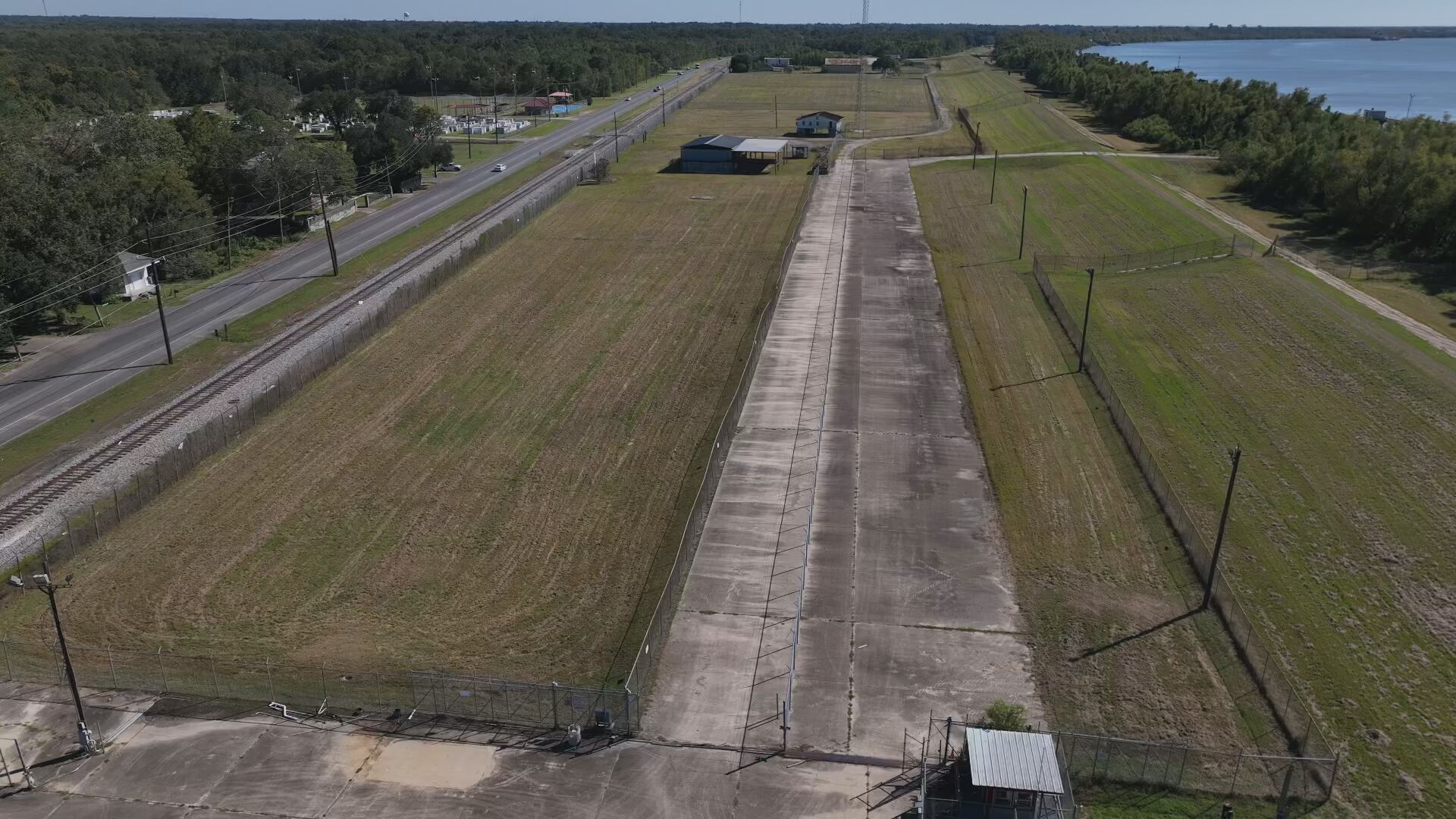
The proposed 400-acre deepwater container terminal would be located further downriver, in the St. Bernard Parish community of Violet. The estimated cost of the project has grown from $1.5 billion in 2022 to $2.6 billion currently. But its completion would mean giant cargo ships wouldn’t have to worry about clearing a bridge. With plans for cargo to move by rail, river and roads, Branch says the LIT will be a pivotal gateway to the Gulf and the Mississippi River.
“When you look at this Mississippi River, and you look at strategically how it connects either through the river itself or its tributaries, you’re talking about 31 states,” Branch said. “There’s nowhere in this country that gives that kind of connectivity.”
Related coverage
- Louisiana International Terminal gets clearance for construction, opponents vow legal fight
- Federal permit granted for $1.8 billion Louisiana International Terminal container ship port
- St. Bernard neighbors have mixed feelings about Louisiana International Terminal
- Port of New Orleans making progress on a planned new $1.5 billion container terminal in St. Bernard Parish
The effort to build the LIT in Violet spans two Louisiana administrations.
It has the backing of current Republican Gov. Jeff Landry and his Democratic predecessor John Bel Edwards. The LIT project cleared a critical review by the U.S. Army Corps of Engineers in August, when it was granted a permit to move ahead with plans to develop hundreds of acres in St. Bernard Parish.
“That permit was everything, because it allowed us to move from this design-and-conceptual stage and be authorized to now construct the terminal,” Branch said.
According to a 68-page memorandum explaining its rationale in granting the permit, the U.S. Army Corps of Engineers said the terminal’s anticipated benefits to the local, regional and national economy outweigh its potential negative impacts, which include the permanent loss of more than 400 acres of wetlands.
The memorandum cited an economic impact study submitted by the Port of New Orleans, which found construction of the LIT alone could generate $1.9 billion for the parishes of St. Bernard, Orleans and Jefferson, and $2.9 billion for the state of Louisiana.
Branch says the terminal also will create thousands of jobs.
“At the full buildout of this terminal, it will be about 4,500 jobs -- indirect or direct -- on the terminal. That’s huge. That means families that live in St. Bernard Parish have children that can remain in St. Bernard Parish and get very prosperous jobs,” Branch said.
Branch says the LIT could also deliver $33 million of tax revenue to St. Bernard Parish every year.
“I think this project is a necessity,” said Cameron Lombardo, a senior sales associate with RE/MAX Commercial Brokers in New Orleans.
Lombardo specializes in commercial developments and real estate and has no financial stake in the LIT or ties to St. Bernard Parish. He says while Meta is building its massive Hyperion data center in northern Louisiana and SpaceX is laying groundwork for its Starbase Louisiana in the southwestern part of the state, the LIT is Metro New Orleans’ best chance of landing a large-scale development.
“I think it’s a huge project,” Lombardo said. “I think it’ll also feed into these other projects by Meta and SpaceX. We’re going to need all the support we can get with the materials and cargo coming in to service these other projects. They’re going to be huge builds that will take years to develop. And having the capacity this port will allow will certainly help those projects and also strengthen the area.”
Not only could the terminal transform St. Bernard Parish, Lombardo says the LIT could possibly bring economic activity to neighboring New Orleans East.
“For years, we’ve been talking about building up New Orleans East,” he said. “A project like this will trickle down to New Orleans East, because there’s only one way in and one way out of St. Bernard, and it’s all connected right there.”
But in Violet, some residents question the economic boom being touted by LIT supporters.
“I’m very skeptical that the money they say it will generate will actually be seen,” said Janet Perez, a resident of Violet.
“They’re making benefit for themselves. They’re not worried about the people down here,” said Mario Williams, another resident of Violet.
And St. Bernard Parish council member Fred Everhardt Jr. said, “What the Port of New Orleans is selling is a steak, and we’re going to get a pork chop, that’s what we’re going to get out of it. Once it goes through and they put boots on the ground, St. Bernard Parish -- for the rest of its entirety, life -- the people here are going to be screwed.”
Everhardt says such a massive project will destroy the way of life in Violet. He points to Merrick Cemetery, which would be surrounded by the terminal’s facilities when completed. Then there’s the issue of traffic. Everhardt says even with a proposal to build an elevated highway to connect terminal traffic to Interstate 10, the two main roads that run through the parish (Louisiana Highways 39 and 46) weren’t designed for the number of 18-wheelers expected to be moving cargo in and out of the LIT. Everhardt said he believes there are better locations for the terminal.
“Plaquemines Parish is ready to take this port,” he said. “It’s further down the river. Go to Port Fourchon with it. You got Highway 1 already built, an elevated roadway. Beef that one up, give it to them.
“Don’t put it in Violet, in a community like this that has houses and developments and schools and churches, right here in the middle of it.”
The Port of New Orleans says that because Violet has access to four interstates, six Class-1 rail connections and 100-year levee protection, it’s an ideal location for the LIT.
Multiple lawsuits from differing parties in St. Bernard Parish have been filed in attempts to block the LIT. One challenges the port’s jurisdiction to operate in St. Bernard Parish. Another seeks to protect W. Smith Elementary School in Violet, which sits inside the proposed footprint of the terminal. The Port of New Orleans wants to relocate the school to a site it says would be more central to the neighborhood. The St. Bernard Parish School Board is pushing back, and recently filed another lawsuit challenging the Army Corps of Engineers’ environmental assessment of the project.
The Port of New Orleans declined to comment on the pending litigation.
St. Bernard Parish District Attorney Perry Nicosia, who represents the parish school board in its lawsuit against the Corps, said in a statement, “Despite Port NOLA spending upwards of $100 million in public funds on land acquisition and securing a conditional permit from the U.S. Army Corps of Engineers (USACE), the terminal project faces an insurmountable legal barrier under Louisiana property law. State statutes ... strictly govern the disposition of immovable public-school property, prohibiting local school boards from arbitrarily selling, transferring or relocating active educational facilities.
“The USACE permit granted to Port NOLA was explicitly contingent upon the full relocation of the elementary school. Because alternative engineering proposals to construct the massive 24/7 container hub around the school were denied due to severe environmental and wetland impact concerns, Port NOLA is now left holding a useless federal permit for property it does not own and cannot acquire.”
Perez called the school “a historic site.”
“I have ties to it. I went to school there,” she said. “I chased my husband around the school yard when we were kids.”
Perez, a retired librarian, has lived in Violet for more than 40 years. She and her husband rebuilt their home after Hurricane Katrina. Now, she’s unsure how long they can stay.
“I’ll either be living next to it or will be forced to move,” she said. “We won’t be able to tolerate living next to it. Or, eventually, they’re going to want the property in the neighborhood. I guess it’s a David vs. Goliath situation.
“I’m going to get emotional and I apologize. This is our home. This is our community and it’s worth fighting for.”
Williams, a truck driver, has lived in Violet since 1996. He says the promised benefits of the terminal would come at the expense of the wetlands and habitat surrounding his blue-collar neighborhood. No job, Williams says, could replace what would be lost.
“I’m a professional driver. I probably could get a job with terminal. But why should I work for something that’s going to destroy my parish?” he said.
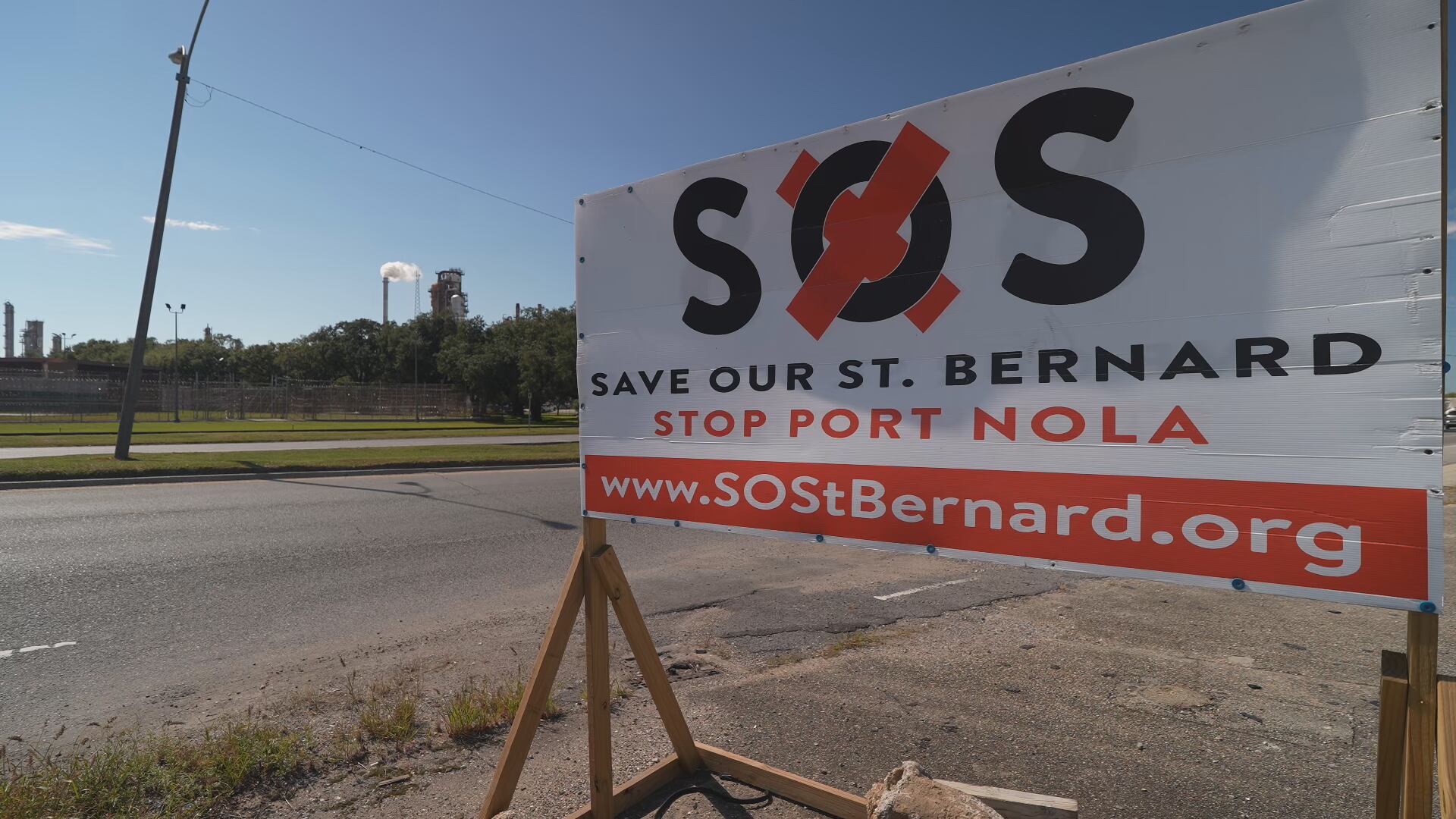
Throughout the parish, SOS (Save Our St. Bernard) signs are posted in front yards, street intersections and on homes. They represent a grassroots opposition to the LIT. But other residents support it.
“I think it would be something big for St. Bernard Parish. It’s going to change the whole thing,” said Roosevelt Walker, a resident of Violet.
Change might be coming soon. If all goes according to the port’s plans, work could begin in a matter of weeks, with an official groundbreaking scheduled for January 2027.
See a spelling or grammar error in our story? Click Here to report it. Please include the headline.
Subscribe to the Fox 8 YouTube channel.
Ver nota original ↗
¿Querés un resumen rápido de esta noticia, hecho por nuestra IA?


