Dubois ranchers balk at oil and gas leases in treasured wildlife habitat in Shoshone, Bridger-Teton national forests
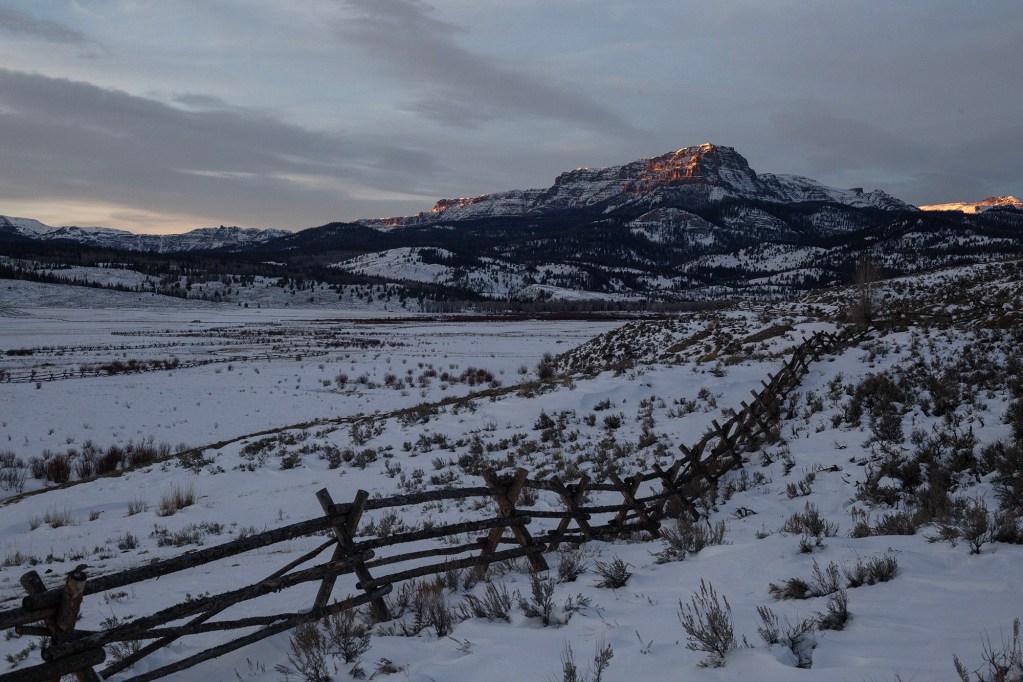
After losing its last timber mill and seeing its economy sputter for decades, there’s a renewed vibrancy in the town of Dubois.
There’s been a stimulus effect from the National Museum of Military Vehicles, but the small community’s modern vitality is all wrapped up in the region’s outdoor splendors, a benefit of its location along the eastern slope of wildlife-rich Togwotee Pass.
“This community is about tourism, hunting, fishing, outdoor recreation and second homes, certainly,” said Budd Betts, a former state lawmaker who represented Dubois in the Wyoming House of Representatives during the 1990s.
Betts, the longtime owner of Absaroka Ranch, is one of several large landowners who are vocalizing concerns about an oil and gas play in the Absaroka and Wind River Range foothills not far from the northwest Fremont County town of roughly 1,000 people.
“It’s just not consistent with where this community is heading,” Betts told WyoFile. “It’s not appropriate for this area, and I’m not speaking as some kind of ‘refuse to oil and gas’ — in my time in the Legislature, I established the bonafides for supporting this state’s energy industry.”
The potential for oil and gas development in the Shoshone National Forest above Dubois could take a step toward reality as soon as next summer.
Although there are no active oil and gas wells in the area, in August a company named Wyoming Energy Consultants nominated nearly 70,000 acres spread across 38 parcels for inclusion in a federal oil and gas lease auction that’s set for June 2027.
The Casper-based business’ “expressions of interest” for leases on the national forest right around Dubois amounts to more than 55% of all the acreage proposed statewide for the quarterly auction, which is administered by the Bureau of Land Management. Across Wyoming, there are 104 parcels covering 123,166 acres being assessed for inclusion in the auction.
WyoFile’s inquiry to Wyoming Energy Consultants yielded no response.
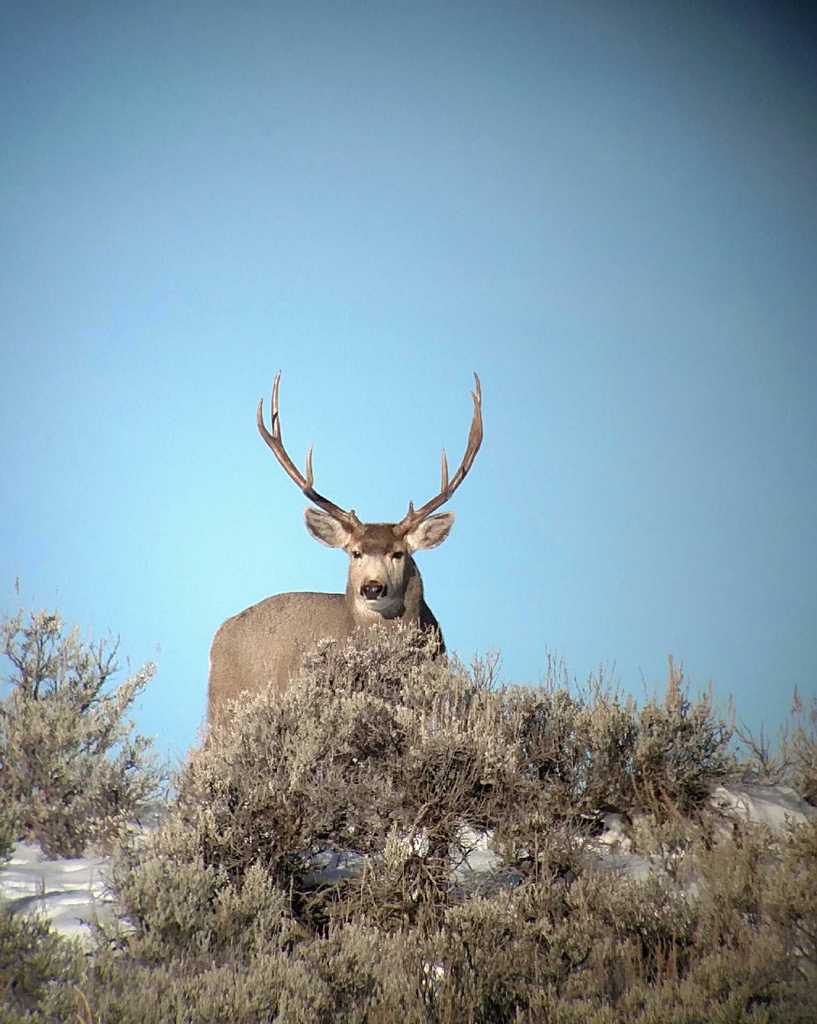
The parcels near Dubois are located both to the north and south of U.S. Highway 26/287 and contain rich wildlife habitat used by the 7,000-animal Wiggins Fork Elk Herd and roughly 4,000-animal Dubois Mule Deer Herd. The mule deer herd in particular is renowned for producing trophy bucks. Acquiring a limited tag to hunt there, in area 128, is nearly impossible: There were 3,834 applicants for 60 licenses during this fall’s hunting season, a 1.5% draw rate.
The landscapes those ungulates move through to reach their seasonal ranges are now at risk of being leased, a precursor to developing well pads.
Trophy bucks on the go
Large reaches of the prospective drilling zone overlap with the Upper Wind River Mule Deer Migration Corridor. In 2024, under former director Brian Nesvik’s leadership, the Wyoming Game and Fish Department opted to “identify” that migration route but not designate and protect it under the state’s migration policy. At the time, agency staff reasoned that there were not substantial enough “threats” and “risks” to the “functionality” of the migration route to justify going through the time-consuming designation process. Some wildlife advocacy groups agreed that the corridor wasn’t in need of protection, but there were exceptions.
Now, just two years later, a development threat that could disrupt the migration is emerging.
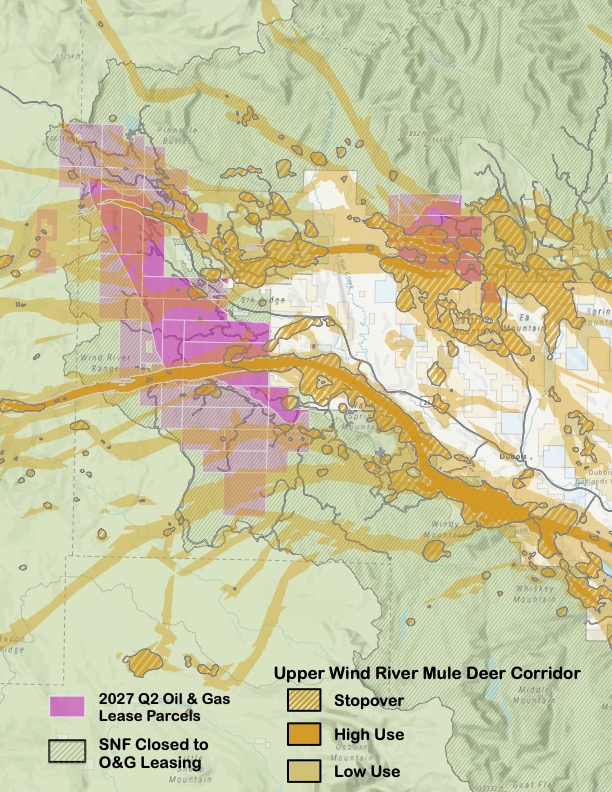
According to an analysis provided by Nick Dobric, a Wilderness Society employee who lives in Dubois, nearly 19,500 acres of the proposed oil and gas leases overlap with the Wind River deer migration corridor. Within that area, there are nooks and crannies that the smaller-than-desired deer herd particularly depends upon. More than 3,000 acres of the leases overlap “high-use” portions of the migration, more than 5,400 acres overlap “stopover” habitat and another 1,400 overlapping acres fall on joint high-use and stopover habitat.
It’s not just mule deer that depend on the area, though.
“It’s a major thoroughfare for everything that lives up [in the Shoshone National Forest] in the summer,” said Jon Robinett, who recently retired after more than three decades of managing the Diamond G Ranch. “Elk, deer, antelope, bears — everything that eats grass — comes through there.”
Roadbuilding to access the exploratory “wildcat” wells would be particularly impactful on the area, Robinett worries.
“Those roads would become more or less public,” he said. “You’d get an impact on recreation, hunting. To me, the downside is the detriment to wildlife.”
Jeremy Prine, whose family has owned the Ram’s Horn Ranch for nearly eight decades, is on the same page. He supports the oil and gas industry and uses its products everyday, but said that the Dunoir Valley isn’t an “appropriate” spot for an exploration project.
“I definitely don’t support oil and gas leases on the national forest in these proposed areas, just due to their wildness,” Prine said. “A lot of those places are starting to disappear.”
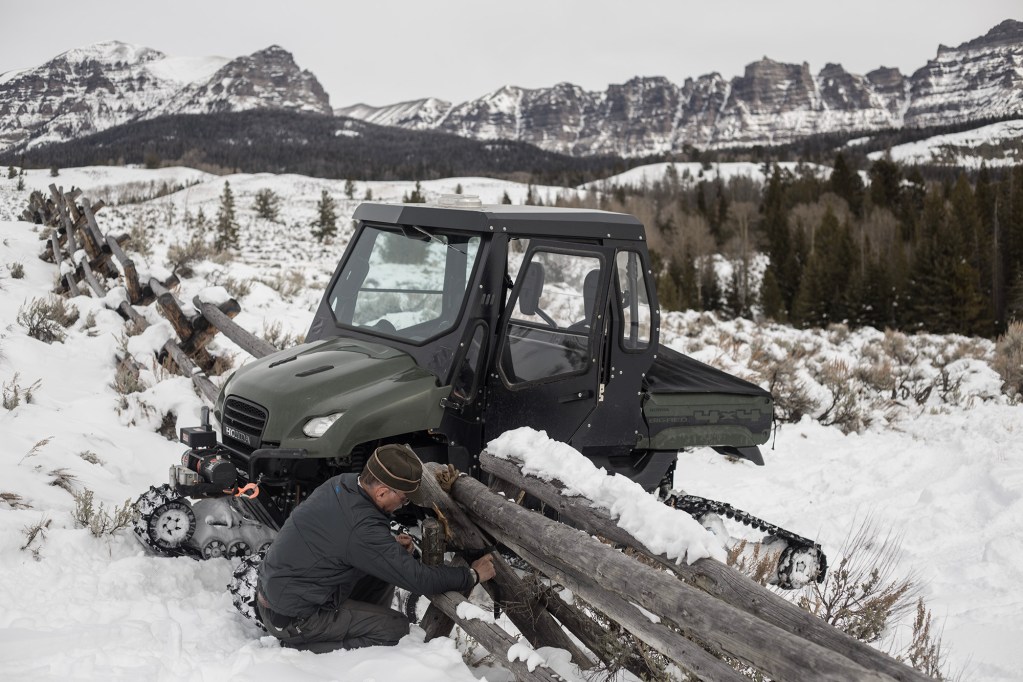
Betts, Robinett and Prine all ranch on the north side of the highway, and they pointed out that companies have prospected for oil and gas in their corner of the Absaroka Range historically. Wildcat wells from the 1970s and 80s were a bust, Betts said, and were capped and reclaimed.
“This was kind of puzzling,” he said, “because the Upper Wind River Valley has some of the lowest oil and gas potential in the state.”
Longtime Dubois resident Robert Hoskins was also perplexed.
“I have no earthly idea why Dubois is a target, other than that they’re going after everything,” he said. “This is the Trump administration.”
Wyoming Energy Consultants’ bid to acquire drilling rights on tens of thousands of acres of the Wind River and Abasorka Range foothills isn’t the first time in the second Trump administration that there’s been an outcry over leasing environmentally sensitive parts of Wyoming. Last fall, another Casper-based company, Kirkwood Oil and Gas, sought to lease acreage in the Golden Triangle, among the most biologically rich reaches of the sagebrush-steppe biome remaining on Earth. Many of the most controversial parcels were deleted, however, because oil and gas leasing there wasn’t allowed under the BLM’s land-use plan.
Next steps
That history could repeat. Roughly 39,000 acres that Wyoming Energy Consultants nominated for leasing in the national forest is located in areas that were closed to leasing in the Shoshone’s 2015 forest plan revision, according to calculations provided by Dobric.
Those nominations will likely be dropped by the BLM during the lease sale vetting process. The BLM’s taking public comment until Nov. 27.
But another 30,200 acres of parcels are located in areas of the Shoshone deemed suitable for oil and gas leasing, including the migration corridor acreages listed above.

Wyoming wildlife managers were also caught off guard by the oil and gas play. Will Schultz, Game and Fish’s habitat protection supervisor, told WyoFile that the proposed leases have put the department in a “unique situation.”
“This is the first time in several years where we’ve seen leases proposed on national forests,” Schultz said.
It’s also one of the first times, he said, that state wildlife managers have navigated oil and gas leasing in an “identified,” but not “designated,” migration corridor.
If the corridor had been designated, the up-for-auction leases would be affixed with stipulations that recognized Wyoming’s migration policy. Although the policy is broadly permissive of development, those stipulations can also be restrictive, especially in the joint high-use and stopover habitat, where the policy states “surface disturbance should be avoided.”
In the absence of a designation, Game and Fish will do what it can to protect the migration route, Schultz said.
“It would take a lot of coordination to ensure the [migration] functionality is maintained,” he said.
For the time being, Schultz is in talks with the BLM and national forests. (A relatively small portion of the proposed leases, about 3,300 acres, are located west of the Continental Divide on the Bridger-Teton National Forest.)
Another option for Game and Fish is to restart its process of formally protecting the migration corridor.
“This particular leasing situation is an opportunity for us to reevaluate that,” Schultz said.
Wyoming Game and Fish commissioners are tasked with making recommendations about migration designations. Ultimately, however, the decision would be made by Wyoming’s Gov.-elect, Eric Barlow, who takes office in January.
The post Dubois ranchers balk at oil and gas leases in treasured wildlife habitat in Shoshone, Bridger-Teton national forests appeared first on WyoFile .
Ver nota original ↗
¿Querés un resumen rápido de esta noticia, hecho por nuestra IA?