Customers turn to WBTV Investigates for help after cyberattack on life insurance company
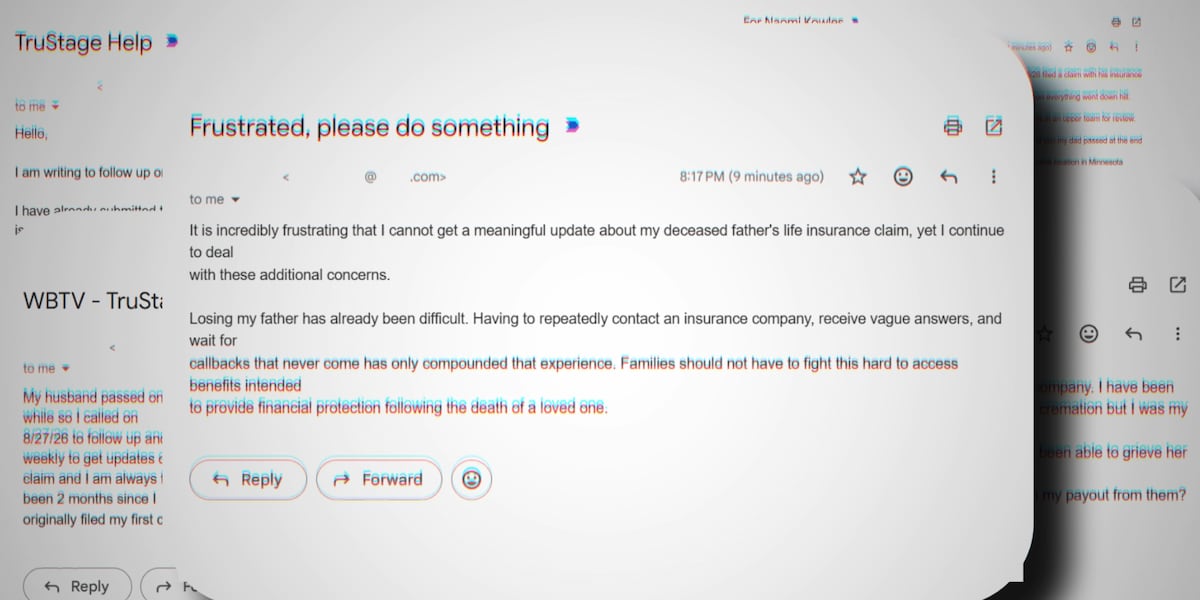
CHARLOTTE, N.C. (WBTV) - Numerous customers who have spent months waiting on life insurance claims turned to WBTV Investigates for help after a July cyberattack on life insurance company TruStage.
After sending a list of the complaints to the company, WBTV Investigates confirmed with all the customers that they received their payments.
In nearly all the cases, customers said they had been placing calls and requests with the company for months with no results before WBTV stepped in.
“I just kept getting the same thing all the time: ‘Well, we can’t do anything, our hands are tied,’” Becky Colchagie said in an interview. “I told them, ‘The money is still being taken out of my uncle’s account for premiums.’”
Within about a week of WBTV sending her information to a TruStage representative in October, Colchagie’s family received the payment they had been waiting for since July.
“If it had not been for you, none of this would have happened,” Colchagie said. “I thank you so much.”
In many cases, customers said they were left in the lurch with funeral homes demanding payments, ongoing life insurance payments being deducted from accounts, and no way to successfully contact the company for help.
“Burial costs are expensive,” Colchagie said. “The funeral home will not wait for their money.”
In a statement, TruStage did not confirm the resolved cases, but blamed the issues on the ongoing impacts of the July cyberattack.
“We understand the frustration it has caused,” a company spokesperson wrote in an email. “We continue to expand servicing and claims capabilities as our recovery progresses, including expanding our customer service support team and creating new processes to help meet customer needs as fast as possible.”
In an update on their website posted Nov. 10, the company said bulk payments for post-outage lending claims had begun, but that claim backlogs remained “substantial.”
“Customers awaiting decisions and payments may still face long waits,” the update noted.
While TruStage declined to provide details on why the cyberattack was taking so long to recover from, cybersecurity firm Fortalice Solutions CEO and former White House Chief Information Officer Theresa Payton shared some insight about the growing trend of corporate cyberattacks nationwide.
“We’re seeing more cyberattacks on everything: every company, every government organization, state, local, federal, as well as individuals,” Payton said. “It’s mostly powered by AI.”
It used to be, Payton explained, that a would-be attacker would need extensive knowledge in both the technology as well as the spoken languages of the corporation or entity they were trying to attack.
Today, artificial intelligence has leveled – and expanded – the playing field.
“Now you can just say to AI, ‘Summarize the latest vulnerabilities that are out there that have been published,’ and then basically just start writing attacks against those,” Payton said.
The timeline of recovery is impacted by how extensive the investigation into the attack needs to be, Payton said. If an attacker has been in the system for weeks, or installed something that can repopulate, it complicates the rebuild.
“You have to pretty much do the full investigation first to make sure you’re not actually going to create yet another problem for yourself,” Payton explained.
In the case of TruStage, where it is now five months and counting since the attack, she says the length of time for recovery is still troubling.
“I’m dismayed that it’s taking this long, because there is technology that if it’s deployed correctly, could help speed up a recovery process.”
Ver nota original ↗
¿Querés un resumen rápido de esta noticia, hecho por nuestra IA?