‘We won’t be playing defense’: San Antonio councilmembers eye expanded legislative agenda after blue wave
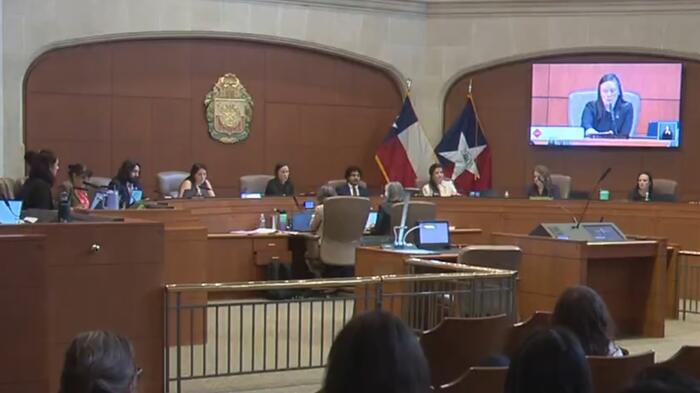
With power in the Texas Capitol set to shift toward Democrats, San Antonio’s left-leaning mayor and council see a rare chance to champion legislation that would have likely been dead on arrival in years past.
Mayor Gina Ortiz Jones and other council members are pushing to explicitly add issues like Medicaid expansion, abortion access, marijuana legalization, immigration enforcement, and raising the state minimum wage into the city’s legislative program.
“It’s been a request by not just the mayor but many council members to revisit this agenda, add some of our priorities, and make sure that we’re tracking and supporting and opposing legislation that our communities have long endured or have recently endured, and figure out opportunities for us to be a little bit more active and a little more effective at the state level this go-around, especially because we won’t be playing defense, hopefully,” Jalen McKee-Rodriguez (D2) said Monday as he began a meeting of the city council’s Intergovernmental Relations (IGR) committee.
The city council approved a legislative program outlining more than 30 city priorities and positions on Oct. 29. Top priorities included protecting the municipal utility model for CPS Energy and SAWS, supporting funding opportunities and legislation to help San Antonio’s planned sports and entertainment district, money and legislation for flood infrastructure, and the planned South Texas Parkway.
Five days later, though, a “blue wave” swept in a Democratic governor, lieutenant governor, and the first Texas House majority in decades, and the council members have looked to reach further.
By that Friday, Jones had already suggested explicitly including several specific goals, like expanding Medicaid coverage, repealing laws about immigration enforcement, repealing a law the city says curbs its authority, Congressional redistricting, and repealing “restrictive reproductive healthcare barriers.”
Though some were arguably extensions of existing priorities or positions in the legislative program, others appeared to be additions.
“I mean, the environment has changed, right? I mean, to be honest, no one would have thought that those things would have been realistic to achieve,” Jones told KSAT on Monday. “But now with — to your point — a different balance of power, we should absolutely ask for these things.”
Ric Galvan (D6) also submitted numerous possible changes in a Sunday memo to McKee-Rodriguez, including minimum breaks for workers in “extreme weather,” a statewide bump in the minimum wage or permission for local governments to set one, and several specific recommendations about data center regulation.
McKee-Rodriguez said he took the two memos and what he had heard from other council members to create a three-page document “that I think encapsulates everything.”
Though city staff presented a handful of possible “adjustments” to the program at Monday’s IGR meeting, they did not recommend “taking on controversial, statewide issues at this time” — giving examples like abortion, paid sick leave, and Congressional redistricting.
“None of this is to say that those aren’t important issues or that they aren’t things that our council would ultimately support,” Assistant City Manager Jeff Coyle told the committee. “But we are recommending that we take our time here, wait to see what the state leadership is going to prioritize in the session before asking you to vote on issues that are somewhat controversial and certainly partisan.
“We’re recommending instead that we stay focused on a very San Antonio-specific agenda to benefit our community and to allow us to align with other cities, other stakeholders, which seem to be galvanizing around this idea of a bipartisan renewed partnership between cities and the state.”
Ultimately, the IGR committee pushed ahead an extensive list of possible updates to the legislative agenda, including those three issues.
Changes would still require approval from the full council, likely at a Dec. 3 meeting.
It’s unlikely to get everyone’s support. Marc Whyte (D10), one of the council’s two conservative members, already called the move to expand the agenda “unfortunate.”
“I think that some of my colleagues on council are looking at the election results and seeing a political opportunity to push a certain agenda that I don’t think the citizens of San Antonio or the people of Texas want,” said Whyte, who believes the results reflect a desire to focus on “day-to-day, quality of life issues.”
“To look at those election results from the other week and think that all of a sudden people in Texas want some far-left agenda — I think people — my colleagues — would be really mistaken to think that.”
Read also:
Ver nota original ↗
¿Querés un resumen rápido de esta noticia, hecho por nuestra IA?