As outages persist, Puerto Rico finds a way to help keep the lights on with 'virtual power plant'
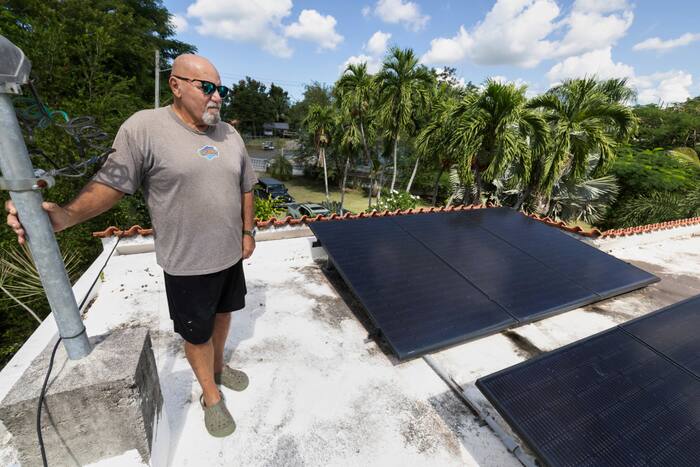
On nearly 20 days in October, an electric utility took energy from a battery attached to Hector Ríos’ house in Cabo Rojo, on the southwest corner of Puerto Rico, and used it to support the power grid.
Ríos was happy to share.
With the U.S. territory's frequent power outages that disrupt daily life and restrain its economy, he likes the idea of helping prevent blackouts for other people. He's also compensated for the energy.
“It just seems like a good deal, to contribute to the community and make money at the same time,” Ríos said.
Ríos, 75, is part of what has become one of Puerto Rico's most effective tools for energy resilience amid nearly a decade of electricity woes: a “virtual power plant,” or VPP, that harnesses batteries from nearly 115,000 households to bolster the grid when its aging and fickle power plants can't meet demand.
Nine years after Puerto Rico's public power utility filed for bankruptcy and Hurricane Maria ravaged its already dilapidated energy grid, residents still face unpredictable blackouts and electricity rates higher than in almost any state. Few new utility-scale power sources have been built since Maria, and most of the federal dollars promised for grid recovery have not yet reached the territory.
But the VPP — the first of its kind in Latin America and the Caribbean, and the U.S.' second largest in terms of capacity — showed its potential this summer, preventing or mitigating outages more than 60 times since June 1, according to Luma Energy, its transmission and distribution utility.
“There’s nothing virtual about it,” said Javier Rúa Jovet, chief policy officer at the Solar and Energy Storage Association of Puerto Rico. “It’s real, and it’s better than a power plant.”
Dozens of states now operate similar networks of distributed energy sources like battery storage systems, electric vehicles and smart thermostats to help manage the grid. Experts expect their role to grow in the U.S. amid energy constraints, rising utility prices, and tech companies’ push to build power-hungry data centers.
As President Donald Trump’s administration promotes fossil fuel expansion and redirects dollars away from solar adoption in Puerto Rico, proponents of the territory's system say it highlights the value of distributed solar and storage, and shows how these systems can bolster resilience for other energy-vulnerable communities.
“There’s a way for this technology to benefit not just the individual buildings that they’re on,” but instead be “in service to the community all the time,” said Nathalie Jordi, community solar lead at Together New Orleans, a nonprofit that championed an upcoming $23 million city program to provide and network over 1,000 batteries on homes and businesses across New Orleans.
A solar revolution after Hurricane Maria
The opportunity to harness a vast network of residential batteries arose after Hurricane Maria in 2017, which left some communities without electricity for nearly a year. Experts linked the infrastructure failure to thousands of post-hurricane deaths.
“We had to procure resiliency in some other way,” said Rúa Jovet, “not a centralized system that will completely fail for a whole year.”
There are now over 207,000 rooftop solar systems on an archipelago of fewer than 3.2 million people, a 20-fold increase from before Maria that was propelled by households who could afford installations, philanthropy, and some federal dollars. Because of the territory's unique need for resiliency, nearly every installation includes at least one battery, a necessary add-on to keep the system running in a blackout.
“The mindset was, get yourself ready for everything,” recalled Ríos, who after Maria bought a diesel generator for his house, then installed panels and a Tesla Powerwall battery in 2023. The system also cut his utility bill in half, from about $400 to $200 in the summer.
Solar panels create an energy boon during the day, charging batteries and sending excess power to the grid. But when the sun sets and demand rises, Puerto Rico barely has enough power to meet the need. Any power plant malfunction can prompt an outage.
In late 2023, Luma launched a small pilot program that would leverage residential battery capacity to offset the shortages. Ríos was among the first to enroll; now over half of solar customers participate.
If Luma predicts an energy deficit, customers are digitally notified that a battery sharing event is coming. They can opt out via app, or adjust how much of their battery — enrollees typically offer 30% — they make available.
The experiment has faced challenges. In a 2026 survey of solar customers by the nonprofit Solar United Neighbors, some participants criticized the compensation structure, which varies by solar provider. Others expressed hesitation to enroll in the program because they did not understand it or feared losing backup power.
Ríos said he’s only had that problem once — when a storm knocked out power right after he shared his battery. He now skips battery sharing events if there's bad weather forecast.
He acknowledged the payment system is “a little vague.” He and his wife received $162 last year, which they happily redeemed as a Marshalls gift card.
Luma told The Associated Press that relying so often on battery sharing has contributed in part to recent rate increases. The utility pays solar providers three times the residential electricity price for the battery energy it takes, recovering the costs through rates.
Rúa Jovet says that expense doesn’t compare to the societywide economic losses of frequent power outages that spoil food, endanger health and shutter schools and businesses. The territory is also set to spend more than $1.7 billion this year importing fuel for most of its power generation.
Creating a consistent energy source
Luma said each battery sharing event, typically about four hours, supports the equivalent of about 80,000 residential customers. Enrolling more households would enable supplemental power for more hours.
But experts believe Puerto Rico can think bigger.
“The VPP in Puerto Rico is like an emergency escape valve, but the batteries should be a grid asset,” said Jigar Shah, director of the Department of Energy’s Loan Programs Office under former President Joe Biden and comanaging director of the advisory firm Multiplier.
Instead of only being tapped in an emergency, Shah said, the batteries could dispatch power every day — offsetting the need to burn fossil fuels — and help absorb excess energy across the grid when solar panels are producing at their peak. Several states, including California and Texas, use solar and batteries this way.
VPPs “could potentially play a larger role in Puerto Rico’s energy future,” Alejandro Figueroa, Luma chief regulatory officer, told The Associated Press. But, he said, a program used daily would require a different design and compensation structure to be sustainable.
Providing daily power is a natural next step, Rúa Jovet said, and could help Puerto Rico meet its own legal mandate that the archipelago reach 100% renewable energy by 2050. But a virtual power plant alone cannot solve the territory’s energy crisis.
That will require deploying billions of unspent federal recovery dollars, continuing improvements to transmission and distribution infrastructure and building new large-scale generation and storage.
“You don’t want the situation to be a persistent emergency forever,” he said.
———
Associated Press coverage of philanthropy and nonprofits receives support through the AP’s collaboration with The Conversation US, with funding from Lilly Endowment Inc. The AP is solely responsible for this content. For all of AP’s philanthropy coverage, visit https://apnews.com/hub/philanthropy.
Ver nota original ↗
¿Querés un resumen rápido de esta noticia, hecho por nuestra IA?