NASA's Voyager Mission reaches a new interstellar milestone
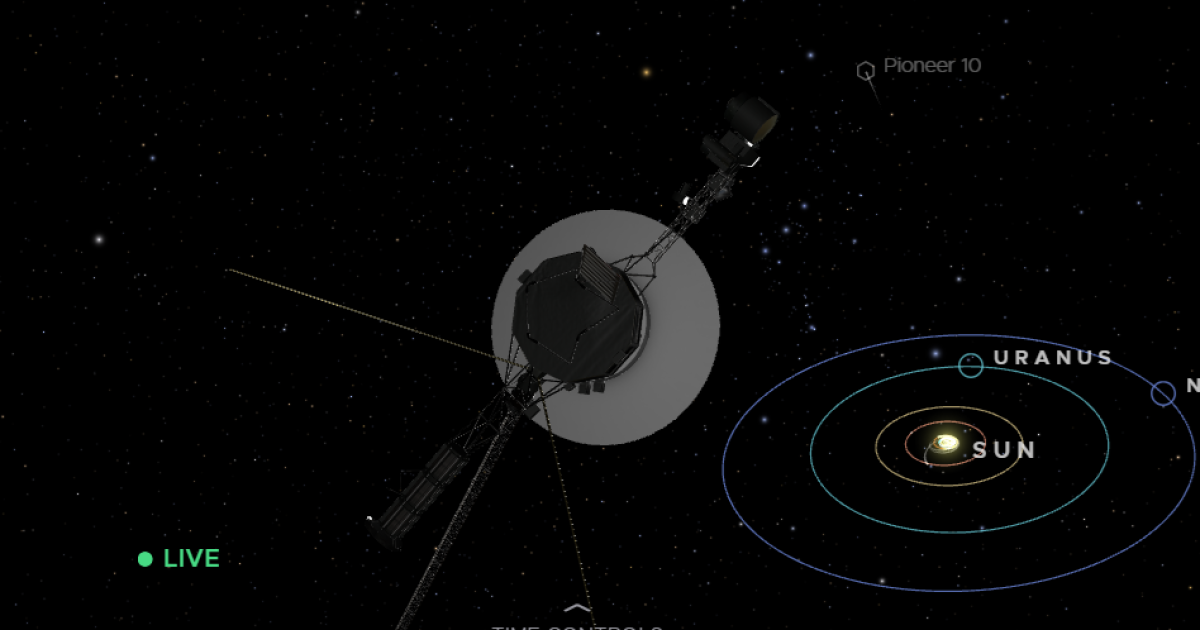
NASAs most distant spacecraft is about to pass an extraordinary new milestone.
On November 18 at 5:16 am EST, Voyager 1 will reach one light-day from Earth. Thats the distance that light travels in 24 hours, or more than 16 billion miles away.
Check out the story in the video player below: NASA's Voyager 1 reaches new milestoneDr. Linda Spilker, a NASA JPL Voyager Project Scientist, says Voyager has outperformed their wildest expectations.
I don't think NASA or anyone imagined that Voyager One would still be operating almost 50 years after launch. I started working on Voyager in 1977. I was there for the launch, and all the planetary flybys. And I remember after the Neptune flyby in 1989, the feeling was it's only going to last a few more years, Dr. Spilker said.
Voyager has transformed our understanding of the outer planets and their moons. It discovered active volcanoes on Jupiters moon Io and observed the first live eruptions ever witnessed on another world.
It took the first family portrait of our solar system. Its most well-known photo, called Pale Blue Dot, captured Earth as a solitary pixel in a beam of sunlight.
Voyager was also the first human-made object to reach interstellar space.
It is still sending data back to Earth, leaving scientists with new questions to explore.
Every once in a while we get a surprise. Voyager 1 in 2020 observed a jump in the magnetic field in plasma that was totally unexpected, and it still persists to this day, Dr. Spilker said.
To celebrate this milestone, NASA is inviting the world to shine bright when the sun goes down on November 17th.
You can do so by using NASAs automated V-G-R flasher or Morse code to signal V G R toward the night sky.
Ver nota original ↗
¿Querés un resumen rápido de esta noticia, hecho por nuestra IA?