THE BREAKDOWN: What are troughs and ridges, and how do they shape our weather?
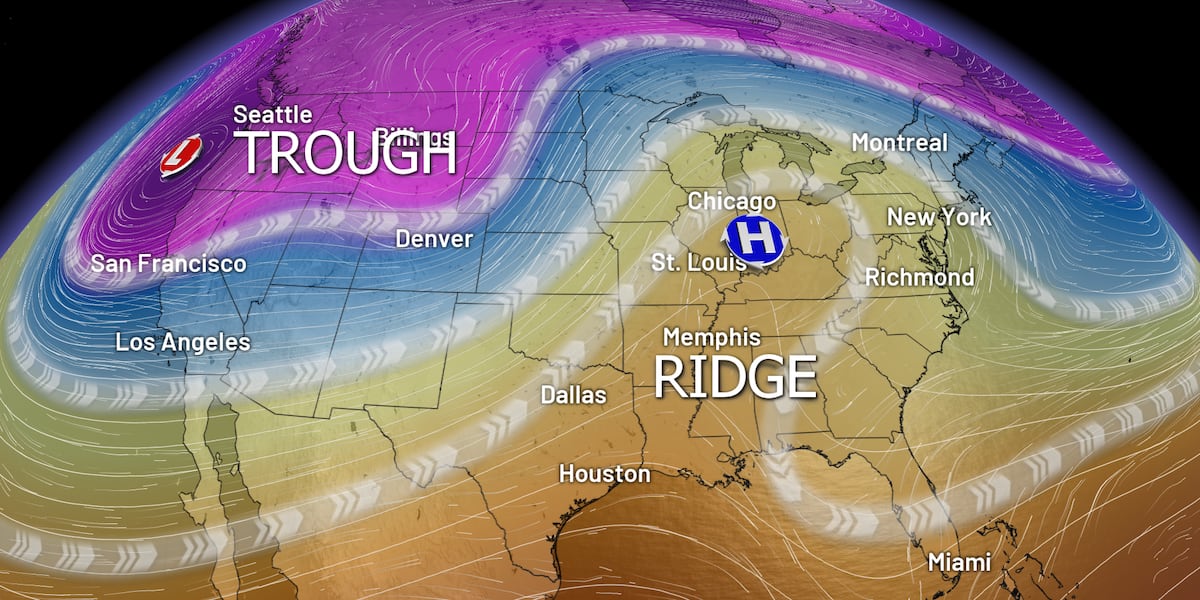
MEMPHIS, Tenn. (WMC) -When meteorologists talk about a trough or a ridge, we’re not talking about something you can see by looking out the window. These features are found high above us, but they help shape the weather we feel down at the surface.
Think of the atmosphere as a moving river of air. Instead of flowing in a straight line from west to east, that river often bends north and south. Those bends can influence where warmer and cooler air go—and where weather systems develop and move.
This week, the Mid-South gets a little bit of both: a ridge is helping bring warmer weather, while a trough and cold front are expected to bring a change by the end of the weekend.
First, what is the jet stream?
The jet stream is a narrow band of strong winds high in the atmosphere. It generally flows from west to east, but it doesn’t travel in a perfectly straight line. Its path can dip south or bulge north as weather patterns change.
Meteorologists also look at upper-air maps, often around the 500-millibar level, roughly 18,000 feet above sea level. The lines on these maps help us spot the larger-scale troughs and ridges that influence the flow of air and weather systems.
What is a trough?
A trough is an elongated area of relatively lower heights on an upper-air map. In the Northern Hemisphere, it often appears as a southward dip in the pattern—like a valley in a wave.
Troughs are often associated with cooler air and can help create conditions favorable for rising air. If enough moisture is available, rising air can lead to clouds, rain or storms.
But a trough is not a guarantee of rain or severe weather. Its strength, position, moisture, and other ingredients all matter. One trough might help produce a significant storm system; another might bring only a few light showers and a change in temperature.
What is a ridge?
A ridge is an elongated area of relatively higher heights on an upper-air map. In the Northern Hemisphere, it often looks like a northward bulge in the pattern—the hill between two valleys.
Ridges are commonly associated with warmer air and sinking air. As the air sinks, it warms and can make it harder for clouds and rain to develop. That’s why a ridge often brings a stretch of warmer, drier and calmer weather.
There are exceptions: A ridge doesn’t mean it will be sunny everywhere beneath it, and clouds or showers can still develop when other ingredients are in place.
How will this affect our weather?
A ridge is helping bring warmer weather to the Mid-South this week, with highs in the lower 70s Thursday through Saturday.
By Sunday, a trough and cold front are expected to bring a few light showers, followed by cooler temperatures early next week.
Click here to sign up for our newsletter!
Click here to report a spelling or grammar error. Please include the headline.
Ver nota original ↗
¿Querés un resumen rápido de esta noticia, hecho por nuestra IA?